|
VOOZH | about |
|
VOOZH | about |
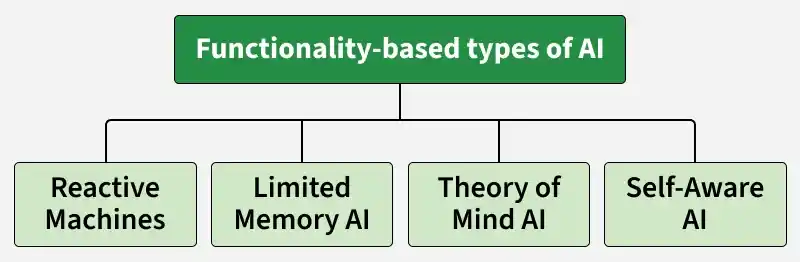
Artificial Intelligence (AI) can be classified based on how it performs tasks, learns from data, and interacts with its environment. This classification helps in understanding its current capabilities and expected advancements.
Reactive AI is the most basic type of AI that responds directly to inputs using fixed rules, without learning from past experiences. It is effective in well-defined, predictable environments where situations do not change much.
Examples: IBM Deep Blue (chess system), Google AlphaGo (match-based decision system), and simple rule-based chatbots used for scripted customer support responses.
Limited Memory AI uses past data to improve current decisions, allowing systems to perform better in changing environments by learning from previous inputs.
Examples: Self-driving cars use past sensor data for navigation, image recognition systems learn from large labeled datasets, and large language models use recent conversation context to generate more relevant responses.
Theory of Mind AI is a developing form of AI that focuses on understanding human emotions, intentions, and social behavior to enable more natural and context-aware interaction.
Examples: Sophia the Robot (Hanson Robotics) demonstrates simulated emotional interaction, while MIT’s Kismet reacts to human voice tone and facial expressions.
Self-Aware AI is a theoretical and most advanced stage of AI that would possess consciousness and an understanding of itself, enabling independent thought and self-directed behavior.
Examples: Fictional systems like HAL 9000 (2001: A Space Odyssey) and Ava (Ex Machina) represent imagined self-aware AI, while real-world implementations do not currently achieve true consciousness.
| Basis | Reactive AI | Limited Memory AI | Theory of Mind AI | Self-Aware AI |
|---|---|---|---|---|
| Level of Intelligence | Basic response-based | Learned from data | Social/emotional (emerging) | Conscious-level (hypothetical) |
| Learning Ability | No learning | Learns from past data | Limited/experimental social learning | Self-reflective learning (theoretical) |
| Decision-Making | Rule-based, immediate response | Data-driven, probabilistic | Context + emotion + intention-based | Fully autonomous, self-directed |
| Interaction Complexity | Simple, fixed responses | Context-aware interaction | Human-like social interaction | Highly advanced, human-equivalent (theoretical) |
| Real-World Status | Fully exists | Widely used today | Research stage | Not yet achieved |