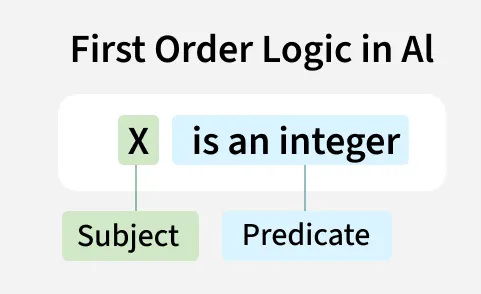
First-Order Logic (FOL), also known as predicate logic, is a knowledge representation technique used in artificial intelligence to represent objects, relationships and rules in a structured way. By extending propositional logic with predicates and quantifiers, it enables AI systems to reason about information more effectively.
Supports logical inference and knowledge-based reasoning
More expressive than propositional logic for complex statements
Commonly applied in NLP, expert systems, and theorem proving
1. Constants: These represent specific objects or entities. Example: Alice, 2, NewYork
2. Variables: These stand for unspecified objects or entities. Example: x, y, z
3. Predicates: These define properties or relationships. Example: Likes(Alice, Bob) means "Alice likes Bob"
4. Functions: It map objects to other objects. Example: MotherOf(x) refers to the mother of x
5. Quantifiers: These define the scope of variables:
Universal Quantifier (∀): Applies a predicate to all elements. Example: means "All persons are mortal"
Existential Quantifier (∃): Shows the existence of at least one element. Example: means "Someone likes ice cream"
6.Logical Connectives: Include conjunction(), disjunction (), implication (), biconditional () and negation ().
Syntax, Semantics and Logical Reasoning
The syntax of First-Order Logic defines the rules for constructing valid logical expressions, while semantics assigns meaning to those expressions based on a domain of interpretation. Together, they allow AI systems to represent knowledge and derive conclusions through logical reasoning.
For example, consider the following statements:
means “All cats are mammals”
means “All mammals are animals”
Cat(Tom) means “Tom is a cat”
Using logical inference, we can derive:
Mammal(Tom) meaning “Tom is a mammal”
Animal(Tom) meaning “Tom is an animal”
This shows how First-Order Logic enables AI systems to infer new knowledge from existing facts and relationships.
Advanced Concepts
Unification: Finds substitutions that make two logical expressions identical. It’s used in automated reasoning to match patterns.
Resolution: Uses inference rules to prove or disprove statements.
Model Checking: Verifies whether a system satisfies given specifications.
Logic Programming: Applies FOL in languages like Prolog for AI applications in areas like NLP and expert systems.
Propositional Logic Vs First-Order Logic
Parameter
Propositional Logic (PL)
First-Order Logic (FOL)
Representation
Represents complete statements as true or false
Represents objects, properties, and relationships
Quantifiers
Does not use quantifiers
Uses quantifiers like
and
Expressiveness
Limited expressiveness
Highly expressive
Reasoning Capability
Handles simple logical reasoning
Supports complex inference and reasoning
Applications
Used in simple logical systems
Used in AI, NLP, and expert systems
Advantages
Represents complex relationships and rules more effectively than propositional logic
Supports logical inference for deriving new knowledge from existing facts
Uses quantifiers to express generalizations and existence statements
Provides a structured framework for knowledge representation and reasoning
Limitations
Computationally expensive for large knowledge bases
Cannot handle uncertainty effectively without extensions
Logical representation of real-world problems can become complex
Some problems in FOL are undecidable and lack guaranteed solutions
Applications
Knowledge Representation: Represents objects, properties, and relationships in a structured form for reasoning tasks
Automated Theorem Proving: Applies logical rules to prove mathematical statements and verify system correctness
Natural Language Processing (NLP): Helps convert natural language into logical representations for understanding and reasoning
Expert Systems: Encodes domain knowledge to support decision-making in systems like medical or legal assistants
Semantic Web: Defines relationships between web resources for improved search and information retrieval