|
VOOZH | about |
|
VOOZH | about |
The rise of transformer models brought major progress in natural language processing, especially with BERT. RoBERTa (Robustly Optimized BERT Pretraining Approach) kept the same architecture but refined the training process to achieve better results. By making some minor changes in BERT, RoBERTa produced stronger language representations without changing the model’s core design.
RoBERTa shares the same transformer encoder structure as BERT, but it introduces several important improvements in how the model is trained:
BERT's pretraining included a task known as Next Sentence Prediction where the model was trained to determine whether two sentences appeared sequentially in the original corpus. This was intended to help the model capture sentence-level relationships.
Later studies showed that NSP contributed little to some task performance and could even introduce noise. RoBERTa removes the NSP objective entirely and focuses solely on masked language modeling (MLM) allowing the model to concentrate on learning better token-level contextual representations.
BERT uses static masking where input tokens are masked once during preprocessing and the same masked patterns are used for every training epoch. This limits the model’s training to varied contexts and can lead to overfitting specific masking patterns.
RoBERTa replaces this with dynamic masking in which masked positions are sampled randomly during each training pass. This ensures the model encounters diverse masking patterns, leading to better generalization and more robust contextual understanding.
Training Deep Learning models requires efficiency with performance. BERT was trained using relatively small batch sizes (256 sequences) and a fixed number of training steps.
RoBERTa scales this up significantly by:
These adjustments provide more stable gradient updates and allow the model to learn deeper language patterns without architectural changes.
One of RoBERTa’s most impactful improvements is its use of a more diverse dataset. While BERT was trained on 16GB of text from Wikipedia and BookCorpus, RoBERTa was trained on over 160GB of text including:
This increase in training data exposes the model to a richer set of linguistic structures and domains, helping it generalize better on real-world tasks.
| Feature | BERT | RoBERTa |
|---|---|---|
| Architecture | Transformer Encoder | Same as BERT |
| Masking Strategy | Static | Dynamic |
| Training Data | 16GB | 160GB |
| Batch Size | 256 | Up to 8,000 |
| Training Steps | 1M | 500K–1.5M (varied across experiments) |
| Optimizer | Adam | Adam with tuned hyperparameters |
Like BERT, RoBERTa uses contextual word embeddings generated through a deep transformer encoder. RoBERTa produces word vectors that change depending on the context in which the word appears.
For example, the word “bank” will have different embeddings in “river bank” and “financial bank”.
These dynamic embeddings are crucial for tasks such as sentiment analysis, question answering and machine translation where understanding context is essential.
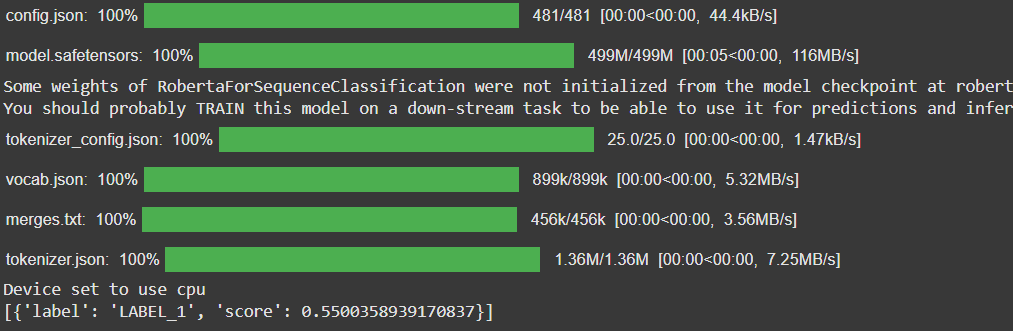
RoBERTa can be easily accessed and fine-tuned using the Hugging Face transformers library. Below is a sample pipeline for sentiment analysis:
pipeline to set up a sentiment analysis task.roberta-base model into the pipeline.Output:
Here we can see that our model is working fine. We can also fine-tune RoBERTa on custom datasets for various NLP tasks such as text classification, named entity recognition and question answering.
RoBERTa has become a strong baseline across many NLP tasks, often outperforming the original BERT in benchmarks like GLUE, RACE and SQuAD. Some real-world applications include:
RoBERTa is widely used for classifying text into categories such as:
Named Entity Recognition (NER) involves detecting and categorizing entities like persons, organizations and locations in text. RoBERTa’s contextual understanding helps improve accuracy in complex and ambiguous contexts.
RoBERTa excels in extractive QA where it locates exact answers from passages. It is used in chatbots, search systems and virtual assistants.
Used in extractive summarization, RoBERTa selects the most relevant sentences from long documents such as articles or reports. It’s ideal for producing concise overviews without generating new text.
RoBERTa variants like BioRoBERTa and Legal-RoBERTa are trained on specialized corpora to support fields like:
While RoBERTa improves on BERT in several ways it still shares some limitations:
Despite these challenges, RoBERTa remains a robust and widely used model in modern NLP systems.
RoBERTa is an example of how training strategies can significantly affect the performance of deep learning models, even without architectural changes. By optimizing BERT's original pretraining procedure, it achieves higher accuracy and improved language understanding across a wide range of NLP tasks.