|
VOOZH | about |
|
VOOZH | about |
Hyperparameter tuning is the process of selecting the optimal values for a machine learning model's hyperparameters. These are typically set before the actual training process begins and control aspects of the learning process itself. Effective tuning helps the model learn better patterns, avoid overfitting or underfitting and achieve higher accuracy on unseen data.
Models can have many hyperparameters and finding the best combination of parameters can be treated as a search problem. The two best strategies for Hyperparameter tuning are:
GridSearchCV is a brute-force technique for hyperparameter tuning. It trains the model using all possible combinations of specified hyperparameter values to find the best-performing setup. It is slow and uses a lot of computer power which makes it hard to use with big datasets or many settings. It works using below steps:
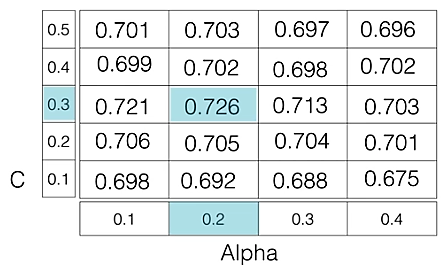
For example if we want to tune two hyperparameters C and penalty for a Logistic Regression Classifier model with the following sets of values:
C = [0.1, 0.2, 0.3, 0.4, 0.5]
penalty = [0.01, 0.1, 0.5, 1.0]
The grid search technique will construct multiple versions of the model with all possible combinations of C and Alpha, resulting in a total of 5 * 4 = 20 different models. The best-performing combination is then chosen.
Example: Tuning Logistic Regression with GridSearchCV
The following code illustrates how to use GridSearchCV . In this below code:
C values using logarithmic scale.C) and its corresponding validation scoreOutput:
Tuned Logistic Regression Parameters: {'C': 0.006105402296585327}
Best score is 0.853
This represents the highest accuracy achieved by the model using the hyperparameter combination C = 0.0061. The best score of 0.853 means the model achieved 85.3% accuracy on the validation data during the grid search process.
As the name suggests RandomizedSearchCV picks random combinations of hyperparameters from the given ranges instead of checking every single combination like GridSearchCV.
Example: Tuning Decision Tree with RandomizedSearchCV
The following code illustrates how to use RandomizedSearchCV. In this example:
Output:
Tuned Decision Tree Parameters: {'criterion': 'entropy', 'max_depth': None, 'max_features': 6, 'min_samples_leaf': 6}
Best score is 0.8
A score of 0.842 means the model performed with an accuracy of 84.2% on the validation set with following hyperparameters.
Grid Search and Random Search can be inefficient because they blindly try many hyperparameter combinations, even if some are clearly not useful. Bayesian Optimization takes a smarter approach. It treats hyperparameter tuning like a mathematical optimization problem and learns from past results to decide what to try next.
Here the surrogate function models the relationship between hyperparameters and the score . By updating this model iteratively with each new evaluation Bayesian optimization makes more informed decisions. Common surrogate models used in Bayesian optimization include: