|
VOOZH | about |
|
VOOZH | about |
Bayesian Optimization is a powerful optimization technique that leverages the principles of Bayesian inference to find the minimum (or maximum) of an objective function efficiently. Unlike traditional optimization methods that require extensive evaluations, Bayesian Optimization is particularly effective when dealing with expensive, noisy, or black-box functions.
This article delves into the core concepts, working mechanisms, advantages, and applications of Bayesian Optimization, providing a comprehensive understanding of why it has become a go-to tool for optimizing complex functions.
Table of Content
Bayesian Optimization is a strategy for optimizing expensive-to-evaluate functions. It operates by building a probabilistic model of the objective function and using this model to select the most promising points to evaluate next. This approach is particularly useful in scenarios where the objective function is unknown, noisy, or costly to evaluate, as it aims to minimize the number of evaluations required to find the optimal solution.
The optimization process involves two main components:
Bayesian optimization effectively combines statistical modeling and decision-making strategies to optimize complex, costly functions. Here’s a more detailed explanation of the process, including key formulas:
The process begins by sampling the objective function at a few initial points. These points can be selected randomly or through systematic methods such as Latin Hypercube Sampling, which helps ensure diverse and comprehensive coverage of the input space.
A Gaussian Process (GP) is typically used as the surrogate model. The GP is favored for its ability to provide both a mean prediction and a measure of uncertainty (variance) at any point in the input space. The GP is defined by a mean function and a covariance function , and it models the function as:
Where:
The next sampling point is chosen by maximizing an acquisition function that trades off between exploration and exploitation. Common acquisition functions include:
Where is the current best observed value of . EI measures the expected increase in the objective function relative to the best current observation.
Where and are the mean and standard deviation of the GP’s predictions at point , and is a parameter that balances exploration and exploitation.
The point selected by maximizing the acquisition function is then evaluated to obtain . This new data point is added to the dataset, which is used to update the GP model.
The steps of updating the acquisition function, selecting new points, and updating the surrogate model are repeated. With each iteration, the surrogate model becomes increasingly accurate, and the search progressively hones in on the optimum.
The optimization process continues until a predefined stopping criterion is met, such as reaching a maximum number of function evaluations or achieving a convergence threshold where the improvements become minimal.
This structured approach allows Bayesian optimization to efficiently navigate complex landscapes, minimizing the number of evaluations needed to locate the optimum by intelligently balancing exploration of unknown regions and exploitation of promising areas.
In this section, we are going to implement Bayesian Optimization using the 'scikit-optimize' library in python.
You can install scikit-optimize using pip if you haven't already:
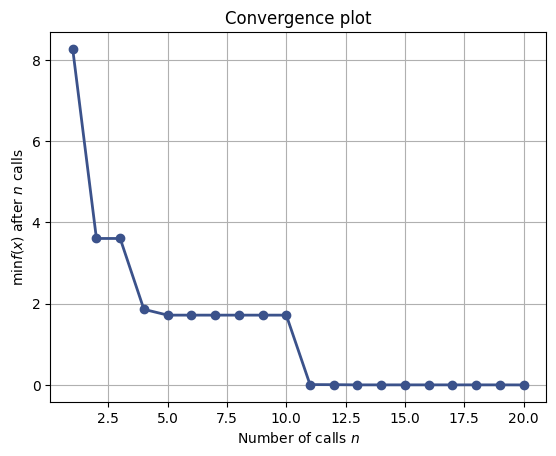
pip install scikit-optimizex as input and returns a scalar value. In this case, the function (x1 - 2)^2 + (x2 - 3)^2 is used as an example, with the minimum at (2, 3).space defines the bounds for the parameters being optimized. Here, both x1 and x2 are real-valued and range between 0.0 and 5.0.scikit-optimize performs Bayesian Optimization. The key arguments include the objective function, the search space, the number of function evaluations (n_calls), and a random state for reproducibility.gp_minimize contains the best parameters found and the corresponding minimum value.Output:
Best parameters: x1 = 2.0003, x2 = 3.0003
Minimum value: 0.0000
The plot and the output together indicate that the Bayesian Optimization process was successful in finding the minimum of the objective function, and it converged efficiently after about 12 evaluations. The final solution is very close to the true minimum of the function, as indicated by the near-zero minimum value.
Bayesian Optimization stands out as a powerful and efficient approach to optimizing complex functions, particularly when evaluations are expensive, noisy, or time-consuming. Its ability to balance exploration and exploitation through a probabilistic surrogate model makes it a versatile tool across various domains, from machine learning to scientific research. By understanding and implementing Bayesian Optimization, practitioners can achieve optimal solutions with minimal evaluations, saving both time and resources in the process.