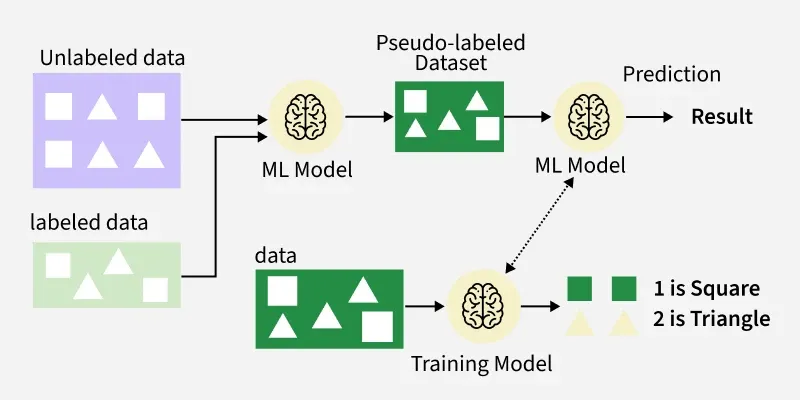
Semi-supervised learning is a distinct machine learning approach that uses a small amount of labeled data along with a large amount of unlabeled data to improve model performance. The goal is to learn a function that accurately predicts outputs based on inputs, similar to supervised learning, but with much less labelled data.
Semi-supervised learning is particularly valuable when acquiring labelled data is expensive or time-consuming, yet unlabelled data is plentiful and easy to collect.
Supervised learning: Similar to a student being taught concepts by a teacher both in class and at home.
Unsupervised learning: Like a student figuring out concepts independently without instruction like a math problem.
Semi-supervised learning: A mix where the teacher provides some concepts in class and the student practices with homework assignments based on those concepts.
Working of Semi-Supervised Learning
Self-Training: The model is first trained on labeled data. It then predicts labels for unlabeled data, adding high-confidence predictions to the labeled set iteratively to refine the model.
Co-Training: Two models are trained on different feature subsets of the data. Each model labels unlabeled data for the other, enabling them to learn from complementary views.
Multi-View Training: A variation of co-training where models train on different data representations (e.g., images and text) to predict the same output.
Graph-Based Models: Data is represented as a graph with nodes (data points) and edges (similarities). Labels are propagated from labeled nodes to unlabeled ones based on graph connectivity.
Let's see an example to understand better.
Step 1: Importing Libraries and Loading Data
We will import the necessary libraries such as numpy, matplotlib and sklearn. We will load IRIS Dataset.
Step 2: Semi-Supervised Setup (Mask Labels)
We will setup the semi-supervised working,
labels is what we pass to the algorithm (contains -1 for unlabeled).
mask is a boolean array indicating which points keep their labels.
labels[~mask] = -1 is a scikit-learn convention where -1 represents unlabeled data.
Print helps readers see how many labels remain (important when describing experiments).
Step 3: Train a Graph-Based Model (Label Propagation)
We will train a graph-based model,
LabelPropagation() builds a graph on X (similarities) and propagates labels from labeled nodes to unlabeled ones.
fit(X, labels) performs the label diffusion — no separate .predict() needed for transduction.
Step 4: Get Transduced Labels and Evaluate
Labels are assigned to all points,
model.transduction_ gives the inferred labels for every sample (including previously unlabeled).
Evaluate both on the small originally-labeled subset (y[mask]) and on the true labels (y) to show how well propagation recovered the full labeling.
accuracy_score is a simple, interpretable metric.
Output:
Labeled samples: 18, Unlabeled samples: 132 Accuracy on labeled data: 1.00 Overall accuracy after label propagation: 0.71
Step 5: Visualize
We will visualize results:
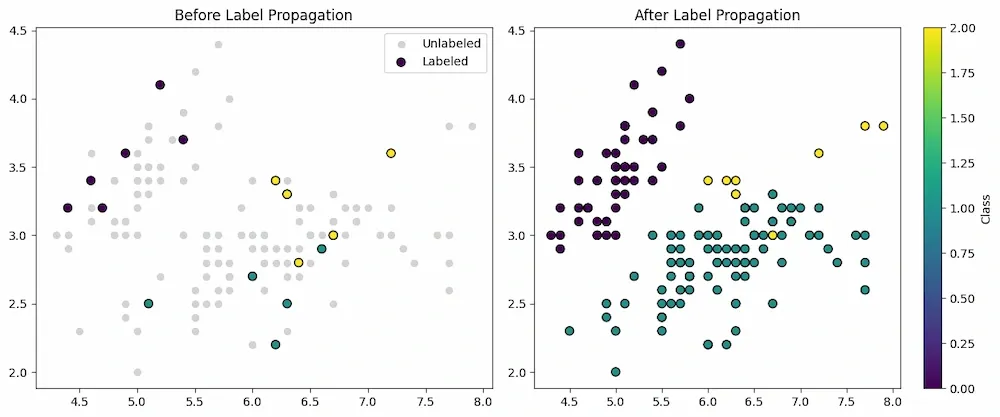
Left plot shows the few labeled examples (colored) against unlabeled (gray).
Right plot shows model’s assigned labels for every point after propagation.
Removing edgecolor avoids common scatter warnings.
As we can see in the result that the model was able to classify images into the categories or labels after successful operations of semi-supervised learning.
When to Use
When labeled data is scarce or costly, such as medical imaging requiring expert annotation.
When large volumes of unlabeled data exist, like social media or web content.
For unstructured data types (text, images, audio) where labeling is difficult.
When classes are rare and labeled examples few, improving class recognition.
When purely supervised or unsupervised methods are insufficient.
Applications
Face Recognition: Enhancing accuracy by learning from limited labeled face images plus many unlabeled ones using graph-based methods.
Handwritten Text Recognition: Adapting models to diverse handwriting styles through generative models.
Speech Recognition: Improving transcription quality by using unlabeled speech data with CNNs and other techniques.
Security: Google uses semi-supervised learning for anomaly detection in network traffic and malware detection.
Finance: PayPal applies it for fraud detection and creditworthiness assessment using transaction data.
Advantages
Better Generalization: Utilizes both labeled and unlabeled data to capture the whole data structure, improving prediction robustness.
Cost Efficient: Reduces dependency on costly manual labeling by exploiting unlabeled data.
Flexible and Robust: Handles different data types and sources, adapting well to changing data distributions.
Improved Clustering: Refines clusters by leveraging unlabeled data, yielding better class separation.
Handling Rare Classes: Enhances learning for underrepresented classes where labeled examples are minimal.
Limitations
Model Complexity: Requires careful choice of architecture and hyperparameters, which may require extensive tuning.
Noisy Data: Unlabeled data may contain errors or irrelevant information, risking degraded model performance.
Assumption Sensitivity: Relies on assumptions such as data consistency and clusterability, which may not hold in all cases.
Evaluation Challenge: Assessing performance is difficult due to limited labeled data and varied quality of unlabeled data.