|
VOOZH | about |
|
VOOZH | about |
Masked Language Models (MLMs) are a type of machine learning model designed to predict missing or "masked" words in a sentence. These models are trained on large datasets of text where certain words are intentionally hidden during training. The goal of the model is to guess the hidden word based on the surrounding context. This approach helps the model learn the relationships between words and develop a deeper understanding of language structure.
The process of training a masked language model involves two main steps:
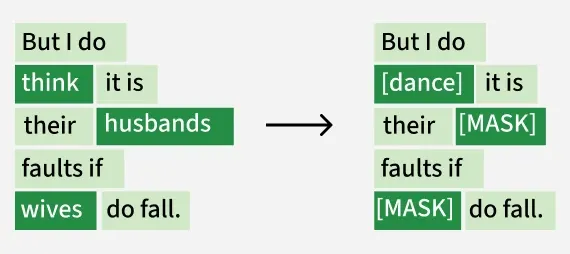
During training, the model is presented with sentences where some words are randomly replaced with a special token, such as "[MASK]." In the below example, two words have been replaced with mask tokens while another word replaced by different word token.
👁 Masked-Language-ModelsThe model is then tasked with predicting the original word that was masked. It does this by analyzing the surrounding words in the sentence. Using the above example, the model would predict "books" based on the context provided by "reads" and "every evening."
This process is repeated millions of times across vast amounts of text data and allow the model to learn patterns, grammar and semantic relationships in language.
Masked language models become important for modern NLP for several reasons:
Unlike earlier models that processed text in a single direction (either left-to-right or right-to-left) MLMs are bidirectional . This means they analyze the entire context of a word—both the words before it and the words after it. This bidirectional approach allows the model to capture richer and more nuanced meanings.
Words can have different meanings depending on the context in which they appear. For example the word "bank" could refer to a financial institution or the side of a river. MLMs excel at understanding these contextual differences because they rely on the surrounding words to make predictions.
Once trained, masked language models can be fine-tuned for a wide range of downstream tasks, such as:
MLMs like BERT (Bidirectional Encoder Representations from Transformers) have achieved groundbreaking results in various NLP benchmarks. Their ability to understand context and relationships between words has set new standards for AI-driven language understanding.
Several models fall under the category of masked language models. Here are a few examples:
The versatility of masked language models makes them applicable to a wide range of real-world scenarios. Some common applications include:
While masked language models have achieved impressive results they are not without challenges:
In the coming years we can expect masked language models to play an even greater role in shaping how humans interact with machines. From smarter virtual assistants to more accurate translation tools the potential applications of MLMs are virtually limitless.