Stemming is a text preprocessing technique in NLP that reduces words to their root or base form by removing prefixes and suffixes. It helps simplify and standardize text, making text analysis and processing more efficient.
Simplifies words into a common root form
Improves text processing and analysis efficiency
Commonly used in text classification and information retrieval
Helps reduce redundancy in text data
May sometimes reduce readability or produce inaccurate root words
Types of Stemmer in NLTK
Python's NLTK (Natural Language Toolkit) provides various stemming algorithms each suitable for different scenarios and languages. Lets see an overview of some of the most commonly used stemmers:
1. Porter's Stemmer
Porter's Stemmeris one of the most widely used stemming algorithms in NLP. It removes common suffixes from English words using a set of predefined rules to produce root forms.
Simple, fast and efficient stemming algorithm
Removes common suffixes from words
Mainly designed for the English language
Widely used in text preprocessing tasks
Stemmed words may not always be meaningful dictionary words
Example
'agreed' → 'agree'
Rule: If the word has a suffix EED (with at least one vowel and consonant) remove the suffix and change it to EE.
Advantages
Very fast and efficient.
Commonly used for tasks like information retrieval and text mining.
Limitations
Outputs may not always be real words.
Limited to English words.
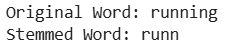
Now lets implement Porter's Stemmer in Python, here we will be using NLTK library.
Snowball Stemmer is an improved version of Porter’s Stemmer, also known as Porter2. It is faster, more aggressive, and supports multiple languages for stemming tasks.
Improved and faster version of Porter’s Stemmer
Removes suffixes more effectively
Supports multiple languages
Commonly used for multilingual text processing
Produces more consistent stemming results
Example
'running' → 'run'
'quickly' → 'quick'
Advantages
More efficient than Porter Stemmer.
Supports multiple languages.
Limitations
More aggressive which might lead to over-stemming.
Now lets implement Snowball Stemmer in Python, here we will be using NLTK library.
Krovetz Stemmer is a linguistically aware stemming algorithm developed by Robert Krovetz. It focuses on preserving the actual meaning of words while converting them into their root forms.
Preserves linguistic meaning more accurately
Handles plural and tense conversions effectively
Produces more meaningful root words
Slower compared to many other stemmers
May be less efficient for very large datasets
Example
'children' → 'child'
'running' → 'run'
Advantages
More accurate, as it preserves linguistic meaning.
Works well with both singular/plural and past/present tense conversions.
Limitations
May be inefficient with large corpora.
Slower compared to other stemmers.
Note: The Krovetz Stemmer is not natively available in the NLTK library, unlike other stemmers such as Porter, Snowball or Lancaster.
Stemming vs. Lemmatization
Let's see the tabular difference between Stemming and Lemmatization for better understanding:
Stemming
Lemmatization
Reduces words to their root form, which may not be a valid word
Reduces words to their base form (lemma), producing a meaningful word
Uses simple rule-based methods
Considers meaning and context of the word
Faster and simpler process
More accurate but computationally heavier
Does not consider part of speech
Uses part of speech and context
No context is considered.
Considers the context and part of speech.
May generate non-dictionary words
Produces valid dictionary words
Example: Better → Bet
Example: Better → Good
Advantages
Normalizes different word forms into a common root
Reduces text dimensionality and improves efficiency
Enhances search and information retrieval performance
Simplifies processing of large text datasets
Improves machine learning and text analysis tasks
Applications
Improves search engine and information retrieval results
Reduces feature space in text classification tasks
Helps group similar documents in document clustering
Enhances sentiment analysis by handling word variations
Improves efficiency in processing large text datasets
Limitations
Over-stemming may reduce words too aggressively and change their meaning
Under-stemming may fail to group related words into the same root form
Ignores context and semantic meaning of words
Can affect accuracy in tasks like sentiment analysis
Different stemmers may produce different results for the same word