|
VOOZH | about |
|
VOOZH | about |
A rule-based chatbot follows a set of predefined rules or patterns to match user input and generate an appropriate response. The chatbot can’t understand or process input beyond these rules and relies on exact matches making it ideal for handling repetitive tasks or specific queries.
First we need to install the NLTK library which will help us with text processing tasks such as tokenization and part-of-speech tagging.
You can install the NLTK library using the following command:
pip install nltk
Once the libraries are installed, the next step is to import the necessary Python modules.
Before proceeding we need to download specific NLTK datasets required for tokenization and part-of-speech (PoS) tagging.
Output:
Rule-based chatbot recognize patterns in user input and respond accordingly. Here we will define a list of patterns and respective responses that the chatbot will use to interact with users. These patterns are written using regular expressions which allow the chatbot to match complex user queries and provide relevant responses.
Now, let’s create a class to handle the chatbot’s functionality. This class will use the Chat object from NLTK to match patterns and generate responses.
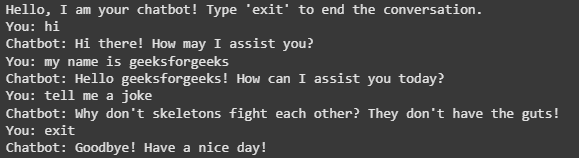
Here we create a function that allows users to interact with the chatbot. It keeps asking for input until the user types "exit".
We instantiate the chatbot class and start the chat.
Output:
You can download the source code from here.
This rule-based chatbot uses a set of predefined patterns to recognize user input and provide responses. While it is limited in flexibility it’s a good starting point for simpler, structured conversations. You can extend this chatbot by adding more complex patterns, integrating machine learning models or incorporating advanced NLP techniques for better accuracy and response handling.