In Natural Language Processing (NLP) textual data must be converted into numerical form so that machine learning models can process it. One-hot encoding is a simple technique used to represent words or labels as numerical vectors.
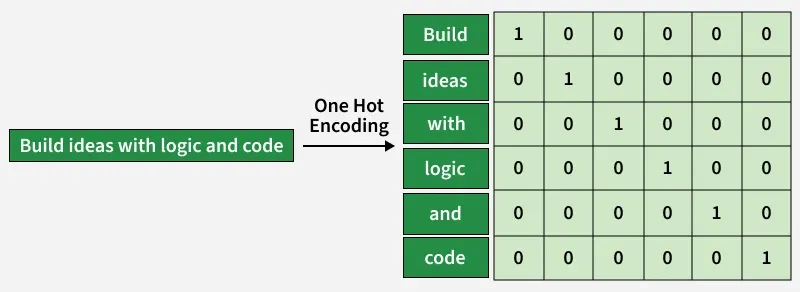
In one-hot encoding each unique word is mapped to a binary vector where only one position has the value 1 and all others are 0. The length of the vector equals the size of the vocabulary making each word uniquely identifiable.
Transforms categorical text data into numeric vectors
Each word is represented by a vector with a single 1 and remaining 0s
Easy to understand and implement
Works well for small vocabularies but becomes inefficient for large ones
How One-Hot Encoding Works
One-hot encoding converts textual data into numerical form by representing each word as a unique binary vector. The process involves the following steps:
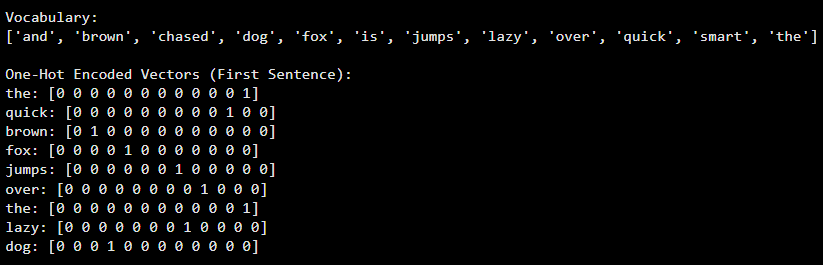
Vocabulary Creation: First a vocabulary is created by collecting all unique words from the entire text corpus. Each word in the vocabulary is assigned a unique index.
Vector Representation: Each word is then represented as a binary vector of length equal to the vocabulary size. The index corresponding to the word is set to 1 while all other positions are set to 0 ensuring a unique representation for every word.
When to Use One-Hot Encoding
One-hot encoding is widely used in Natural Language Processing (NLP) and machine learning when categorical data needs to be converted into a numerical format for model training.
Text Classification: Used to represent words or documents numerically in tasks such as spam detection, sentiment analysis and topic classification.
Feature Engineering: Applied when categorical features must be included as input features in machine learning models.
Embedding Layers: Often used as an initial step before embedding layers in deep learning models to prepare categorical input data.
Label Encoding: Used to encode categorical target labels in classification problems so that models can process them correctly.
Difference Between One Hot Encoding and Word Embeddings
Here we compare one hot encoding technique with word embedding
Parameter
One-Hot Encoding
Word Embeddings
Vector Type
Binary vector
Dense numerical vector
Vector Dimension
Equal to vocabulary size
Fixed and low
Sparsity
Highly sparse
Dense
Semantic Information
Not captured
Captured
Memory Efficiency
Low
High
Scalability
Poor for large vocabularies
Scales well
Why One-Hot Encoding is Used in NLP
One-hot encoding is used in Natural Language Processing (NLP) to convert categorical text data into numerical form enabling machine learning models to process and analyze textual information effectively.
Numerical Representation: Machine learning algorithms require numerical input and one-hot encoding converts words, tokens or part-of-speech tags into binary vectors.
Distinct Token Identification: Each word is represented uniquely ensuring no ordinal or priority relationship between tokens.
Model Compatibility: One-hot encoded vectors can be directly used as inputs to machine learning and neural network models.
Use in NLP Tasks: Commonly applied in tasks such as sentiment analysis, text classification and language modeling.
Advantages
Simple and Interpretable: Each word or category is represented using a binary vector making the encoding easy to understand and implement.
No Ordinal Bias: One-hot encoding treats all words equally and does not introduce any unintended ordering or priority among tokens.
Suitable for Categorical Data: Works well when dealing with categorical text features with a small or fixed vocabulary.
Model Compatibility: Can be directly used as input for traditional machine learning models and basic neural networks.
Foundation for NLP Pipelines: Often used as an initial text preprocessing step before applying more advanced NLP techniques.
Limitations
High Dimensionality: Large vocabularies result in very high-dimensional vectors increasing memory usage and computational cost.
Sparse Representation: Most elements in the vector are zeros leading to inefficient storage and slower model training.
No Semantic Information: Fails to capture relationships or similarities between words.
Poor Scalability: Becomes impractical for real-world NLP tasks involving millions of unique words.
Inferior to Embeddings: Modern NLP tasks prefer word embeddings which represent words as dense, low-dimensional vectors that preserve semantic meaning.