|
VOOZH | about |
|
VOOZH | about |
Motorola’s Six Sigma is a systematic methodology for quality management and process improvement developed in the 1980s to reduce defects, minimize process variations, and improve overall efficiency. It provides organizations with a structured approach to analyze processes, identify root causes of problems, and implement long-term improvements that enhance product quality and customer satisfaction. Originally introduced by Motorola to address rising quality issues and global competition in manufacturing, Six Sigma proved highly successful in improving reliability and reducing errors, leading to its widespread adoption across manufacturing and service industries worldwide
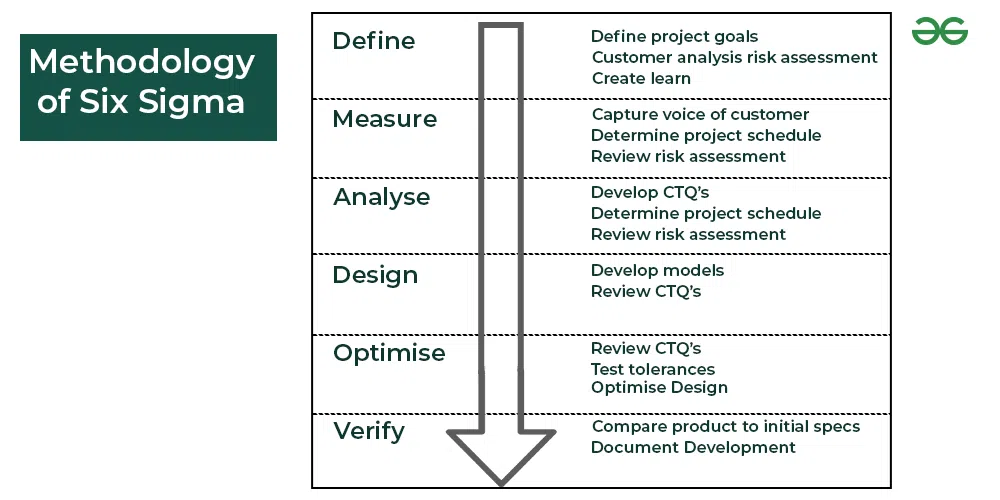
👁 Methodology of Six SigmaSix Sigma measures process performance using defects per million opportunities (DPMO), where a defect refers to any outcome that does not meet customer requirements. Achieving a Six Sigma level means a process produces only 3.4 defects per million opportunities, representing a very high standard of accuracy, consistency, and quality. This statistical approach enables organizations to measure quality performance, compare processes, and establish clear improvement benchmarks. To implement Six Sigma effectively, organizations follow a structured methodology that focuses on improving existing processes or designing new ones by defining requirements, analysing variations, optimising performance, and verifying results. Through this systematic approach, Six Sigma ensures that customer expectations and process capabilities are closely aligned, helping organizations build quality directly into their processes and achieve continuous improvement
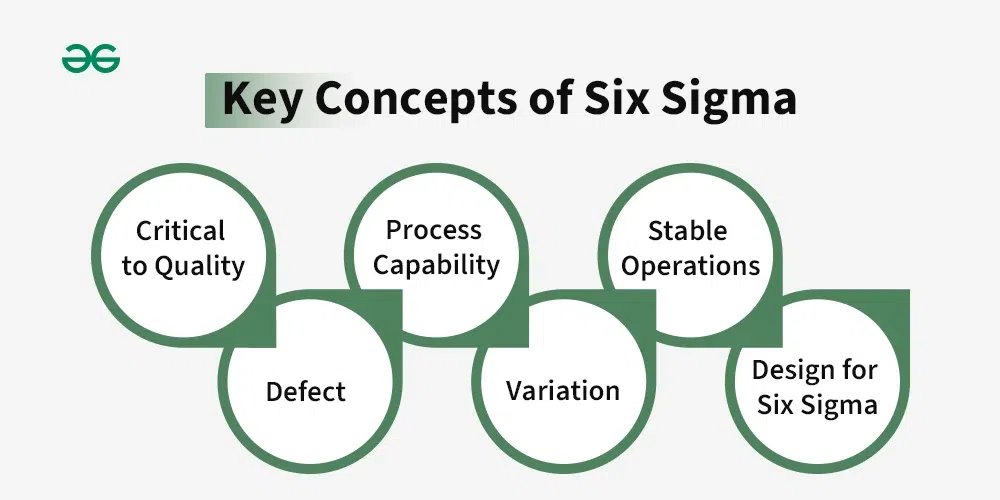
Six Sigma is based on certain fundamental concepts. These key concepts are given below.
👁 key-concept-of-six-sigma-copy
Critical to Quality (CTQ): Critical to Quality refers to the features of a product or service that are most important to customers. These attributes directly affect customer satisfaction and are translated into measurable standards for quality improvement.
Defect: A defect is any failure to deliver what the customer values. It occurs when a product or service does not meet CTQ requirements, leading to dissatisfaction and the need for rework or correction.
Process Capability: Process capability indicates how well a process can consistently produce outputs within customer specified limits. A capable process shows low variation and delivers reliable results.
Variation: Variation represents inconsistency in process output that the customer experiences. High variation leads to unpredictable quality, while reducing variation improves consistency and customer satisfaction.
Stable Operations: Stable operations ensure that processes run in a consistent and predictable manner over time. Controlled and stable processes help maintain quality improvements and reliability.
Design for Six Sigma (DFSS): Design for Six Sigma focuses on designing products and processes that meet customer needs and process capability from the beginning, reducing defects and improvements later.
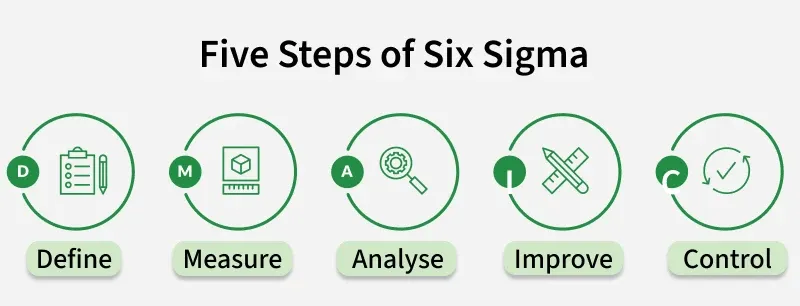
The Six Sigma methodology follows a well-defined and structured approach known by the acronym DMAIC: Define, Measure, Analyze, Improve, and Control.
Define: The Define stage focuses on clearly identifying the problem that needs improvement. In this phase, the objectives of the project are clearly stated, customer requirements are understood, and the scope of the process is defined. Critical to Quality factors are identified to understand what is most important from the customer’s point of view. A clear problem statement, project goals, timeline, and team responsibilities are established so that everyone involved has a common understanding of the purpose of the project.
Measure: The Measure stage involves collecting relevant and reliable data to understand the current performance of the process. Existing processes are mapped, and key performance indicators are selected to measure efficiency, quality, and defect levels. This stage helps in establishing a baseline, which shows how the process is currently performing. Accurate measurement is essential because it provides factual evidence of problems and helps in comparing performance before and after improvements.
Analyse: In the Analyse stage, the collected data is examined to identify the root causes of defects and variations in the process. Various analytical and statistical tools such as cause and effect diagrams, Pareto charts, and process analysis are used to understand why defects occur. The focus is not on symptoms but on underlying causes. This stage ensures that improvements are based on facts and data rather than assumptions or guesswork.
Improve: The Improve stage aims at developing and implementing solutions to eliminate the root causes identified in the analysis phase. Alternative solutions are evaluated, and the most effective ones are selected. Process changes, redesigns, or technological improvements may be introduced to enhance performance. Pilot testing is often done to check whether the proposed solutions work effectively before full scale implementation. This stage leads to measurable improvements in quality, efficiency, and customer satisfaction.
Control: The Control stage ensures that the improvements achieved are sustained over the long term. Standard operating procedures, control charts, and monitoring systems are established to maintain process stability. Employees are trained to follow new standards, and regular reviews are conducted to prevent the process from reverting to its previous state. This stage helps in embedding continuous improvement into the organizational culture.