|
VOOZH | about |
|
VOOZH | about |
Project procurement management is an important aspect of good project management because it deals with the acquisition of supplies and services from suppliers outside the firm to complete projects. This process includes planning, buying, and controlling the purchase of goods or services that are necessary to be able to finish a project successfully. It falls under one of the categories of knowledge specified in the Project Management Body of Knowledge (PMBOK) by the Project Management Institute (PMI).
Table of Content
The practice of controlling and optimizing a project's budget as it relates to the supplies, services, and equipment you'll need to finish your project is known as procurement management. Raw materials, construction space, hosting, independent contractors, and intellectual property are a few examples of resources, and a large number of them will come from outside providers. In order to govern how purchases are made in your company, this involves developing a procurement management plan, evaluating quality, overseeing procurement contracts, carrying out purchases, and any other necessary tasks.
It is the building and maintenance of connections with outside resources required to finish a project. A project procurement manager negotiates prices with suppliers to purchase, lease, or contract the goods and services required to meet project goals.
After project selection, Project Procurement Management invloves several important aspects such as procurement activities that are coordinated and managed throughout the life of a contract or an agreement to achieve successful acquisition. For successful planning, execution, and control of the procurement process, these components are crucial. Here are the key components:
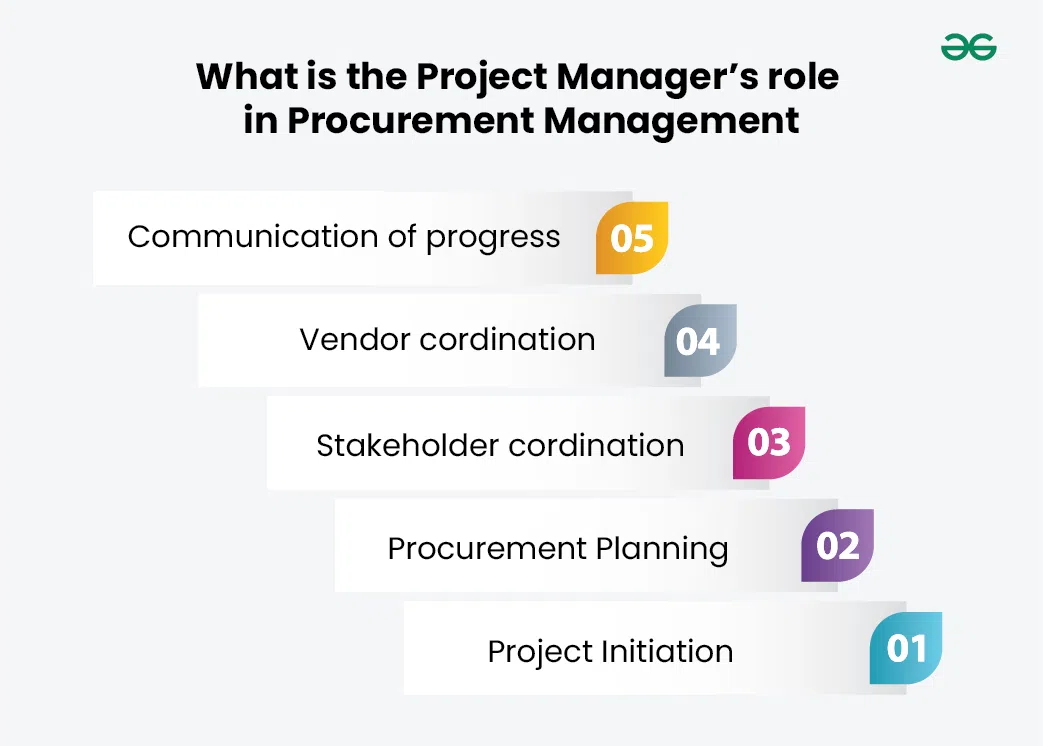
Like every other part of the project management process that they have authority over, procurement is handled by the project manager. They might not have the same control over this process as they do over other project components, though. Although the project manager is authorised to negotiate contracts with contractors on the company's behalf, once a contract is in place, the project manager is frequently not the one responsible for managing it. In any case, keeping the project manager informed is crucial.
An organization's requirements, policies, and general procedure for procurement are described in a procurement management plan for a specific project. Each organisation has a different level of complexity and detail when it comes to their procurement management plan. it should include:
Overall, the Procurement Management Plan acts as a manual for efficiently handling procurement procedures to guarantee that project goals are fulfilled on schedule, within budget, and with the appropriate level of quality.
Procurement planning belongs to a vital project lifecycle, and its value can hardly be underestimated. A successful procurement plan lays the ground for effective acquisitions, completes projects, and ensures that resources are secured effectively. Here are some key reasons highlighting the importance of procurement planning:
Here are the following Benefits of Project Procurement Management:
An essential step in procurement is to ask for proposals from possible vendors and suppliers. This practice assists in finding the best vendors, securing competitive quotes, and choosing the most appropriate supplier for a given project. Here are the key steps involved in soliciting proposals:
State the requirements of the project, what needs to be done, and specifics. This information delivers a holistic picture to potential vendors of what is anticipated and leaves them capable of submitting viable proposals.
Develop a detailed RFP or RFQ that outlines not only the project objectives and scope but also deliverables, and timelines within investiture according to actions taken in respective sections of this document under, evaluation filler including all criteria-driven characteristics, considerations as well specifics. This document helps vendors propose their offerings.
Hazard the RFPPR Note, consider circulating the Dispenser RFQ to potential area vendors. This can be done by ways of different services, like online shopping platforms, emails, or a special procurement website. Make sure that the distribution is wide enough to enable a fairly large pool of qualified vendors.
Hold a pre-bid conference meeting, that will enable potential vendors to clarify doubts and ask questions pertaining to the requirements. Thus, this meeting allows a better understanding of the project and guarantees that all vendors simply have consistent information.
Establish communication lines with the vendors, where they can either place inquiries or seek clarifications during this period of proposal preparation. Swift replies to questions, that vendor asks have a positive effect on equitable and competitive procurement process.
Request vendors to submit their offers by a particular date. Make the submission process straightforward and include such details as how it should be submitted, with whom to contact for this sort of action, what format needs to consist submissions in along with any special qualifications they may have.
Form a proposal evaluation team to evaluate received proposals with respect to predefined criteria. Take into account the price, technical possibilities, experience, and correspondence to project requirements. Establish a scoring system to compare and rank proposals in an objective manner.
Based on the assessment, choose a vendor who is best fit for project needs and best value. Do not consider the cost alone, but look at how good a vendor is. It depends on its reputation in business as well as what projects it has been able to do before and whether or not they were successful. Moreover, vendors have time deadlines, so choose one that can definitely get things done on time.
Proceed to negotiate the contracts with the chosen vendor in order to reach an agreement on specific terms, justification of pricing, and conditions. The negotiations may have adjustments in the scope of work, delivery dates, or any other elements of a contract.
When negotiations are successfully concluded, award the contract to his or her selected vendor. Send a formal letter indicating that the chosen vendor has been awarded. If appropriate, keep unsuccessful vendors informed of the decision.
Submit the requisite paperwork to implement a contract. Make sure both parties have a clear picture of what they owe each other and that laws or regulations necessary for the deal are observed.
First and foremost, relationships should be established with various stakeholders within the organization by communicating to them that they have been awarded a contract. Offer advice about what to do next and perhaps establish communication lines prior to that in case there are any concerns or doubts.
Here's a comparison of Procurement Management and Purchase Management in tabular form:
| Aspect | Procurement Management | Purchase Management |
|---|---|---|
| Scope | Strategic process | Operational process |
| Focus | Broad range of activities | Specific purchasing activities |
| Activities | Supplier selection, contract negotiation, vendor management, supply chain management | Placing orders, tracking deliveries, processing invoices |
| Objective | Achieving strategic objectives (cost savings, risk mitigation, supplier relationship management) | Fulfilling immediate purchasing needs |
| Importance | Integral to overall business strategy and operations | Essential for day-to-day operations |
Here are some of the real world Examples of Project Procurement Management:
The Panama Canal Expansion Project or the Third Set of Locks project focused on enlarging it with a capacity to accommodate larger vessels and this enhanced its functionality as well as global shipping efficiency.
Procurement Practices:
Outcome:
The expansion project spanning 2014 – 2016 saw the doubling of capacity along with largerer “New Panamax” can navigate through the canal. Procurement management strategies proved to be successful during the project because of their positive effect on global maritime trade routes in both conditions.
T5 Heathrow Terminal is a large expansion concerning London’s famous international airport. It's sole purpose was to enlarge in capacity and make the passengers enjoy their interfacing more enjoyable.
Procurement Practices:
Outcome:
2008 saw the official opening of Heathrow Terminal 5. The project was completed on time and under budget, evidencing strong procurement management approaches that focused on cooperation with all stakeholders, minimizing risks throughout the lifecycle of a contracted agreement while seamlessly using modern technologies. These cases point to the need for strategic planning initiatives, collaborative procurement strategies, risk management and use of technology in project procurement.
The project procurement management is a pivotal component of project management, which focuses on acquiring goods and services that are necessary for meeting requirements determined by projects. Procurement management is a key component of ensuring project success, controlling costs and managing risks.