|
VOOZH | about |
|
VOOZH | about |
Pre-Requisite:
What is Directed Graph? | Directed Graph meaning
Dynamic Programming (DP) Tutorial with Problems
Every Dynamic Programming problem can be represented as a Directed Acyclic Graph(DAG). The nodes of the DAG represent the subproblems and the edges represents the transitions between the subproblems.
Table of Content
Let's take an example to understand the above points:
Finding Longest Path in Directed Acyclic Graphs (DAG):
The dp state and the transition in this case will be:
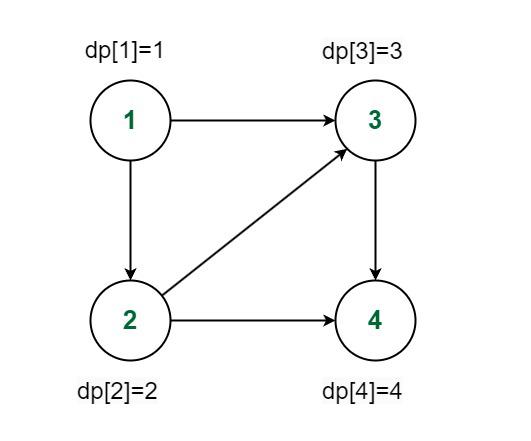
Let dp[v] denote the length of the longest path ending at the node v. Initialize all the positions in dp array as 1. Clearly,
For every edge from node u to node v, dp[v] = max (dp[u]+1)
At the end check for the maximum value in dp[] array, which will be the longest path in the DAG.
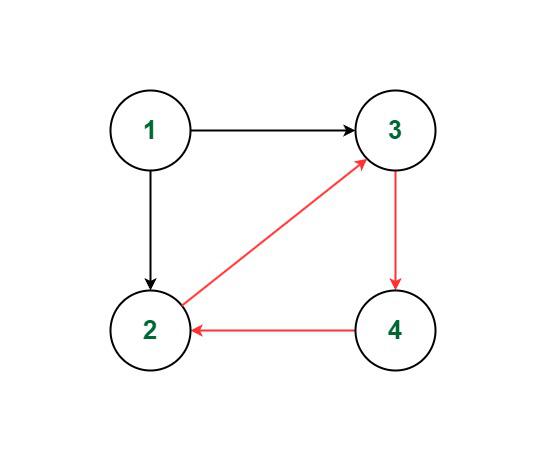
If the graph contains a cycle, then some states would lead back to themselves after a series of transitions. This would lead to infinite calculations. Thus, answer will not exist if the graph is cyclic in this case. As shown in below image, we potentially keep traversing the cycle indefinitely, making it impossible to find the longest path.
Let us consider few problems which will tell how to define the states and make the transition:
Given a Directed Acyclic Graph consisting of N nodes and M edges. The task is to determine the number of different ways to reach Node N from Node 1.
Solution: The problem can be solved in following steps:
As mentioned above each Nodes of Directed Acyclic Graph represents a state. Let dp[v] be the number of ways to reach Node N from the vertex v.
Like the Nodes represents states in the DAG, similarly the edges represent transition. Thus dp[v] can be calculated by:
dp[v] = Σdp[u], for every edge v->u
We process the nodes topologically i.e., if edge v->u exists then dp[u] should be computed before dp[v].
Hence ,dp[1] will be our final answer.
Below is the implementation of above approach:
No. of ways to reach Node N from Node 1: 2
Time Complexity: O(N), Where ‘N’ is the number of nodes in the given graph.
Auxiliary Space: O(N)
Given a Directed Acyclic Graph consisting of N nodes and M edges. Each node is assigned a lowercase alphabet representing the color of that node ('a' to 'z'). The task is to determine the largest value of any path. The value of a path is defined as the number of nodes which are colored with the most occurring color in the path.
Solution: The problem can be solved in following steps:
We can observe that there are total 26 colors possible. So, we can make a 2D dp[][] array of size N*26. Let dp[v][i] represent the maximum count of vertices having color i of any path starting from vertex v.
Again, like the Nodes represent states in the DAG, similarly the edges represent transitions. Thus dp[v][i] can be calculated by:
dp[v][i] = max(dp[u][i]+col, dp[v][i]), for each edge v->u and each color i from 0 to 25. The value of col will be 1 if color of vertex v is equal to i otherwise it will be 0.
Again, we process the nodes topologically i.e., if edge v->u exists then the node u should be processed before node v.
Hence, our final answer will be maximum of dp[v][i] for each vertex from 1 to N and color from 0 to 25.
Below is the implementation of above approach:
Maximum count of vertices having the most occurring color: 3
Time Complexity: O(N), Where ‘N’ is the number of nodes in the given graph.
Auxiliary Space: O(N)
Longest path in a directed Acyclic graph |
|---|
Longest Path with Maximum Letter Frequency |
Minimum path need to reverse to reach each node in a tree from each vertex |
Two-Color Sorting |