|
VOOZH | about |
|
VOOZH | about |
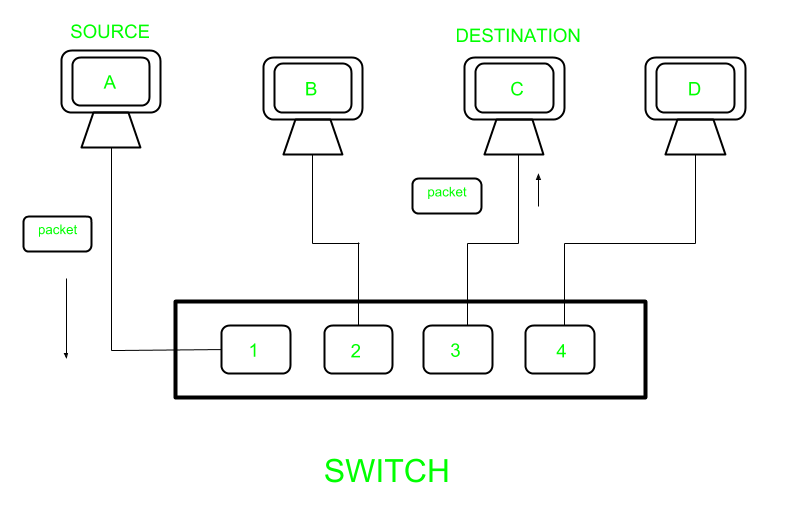
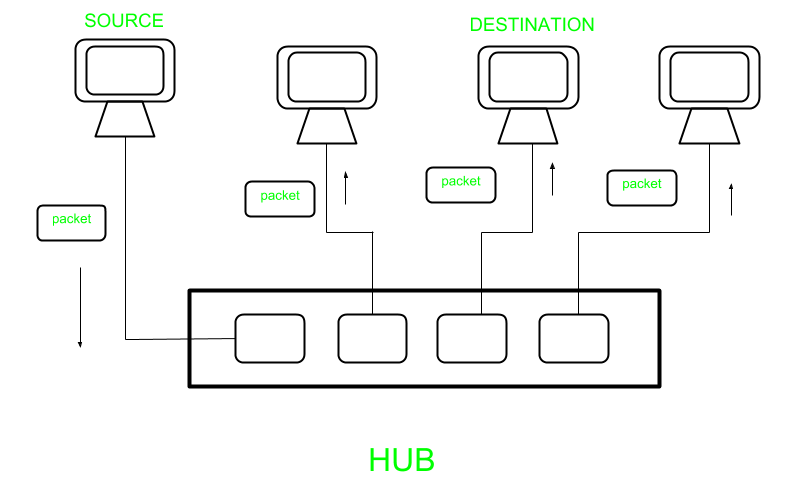
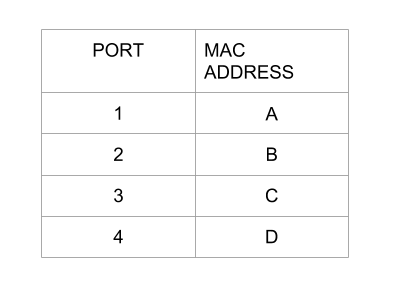
A switch is a device that sends a data packet to a local network. What is the advantage of a hub? A hub floods the network with the packet and only the destination system receives that packet while others just drop due to which the traffic increases a lot. To solve this problem switch came into the picture. A switch first learns, by flooding the network just like a hub to fill the MAC- address table, on which port a particular device is connected. After learning it sends packets to that particular host only.
A Layer-2 switch works at the Data Link layer or Layer 2 of the OSI reference model. It especially utilizes MAC addresses to direct information packets between devices that are on the exact same network.
A Layer-3 switch works at the third layer of the OSI mode and it has features of both a switch and a router. It employs IP addresses in the forwarding of packets and routing among one or different networks/subnets. Layer-3 switches are characterized by:
Layer 2 switch work on layer 2 of OSI model i.e. data link layer and sends a "Frames" to destination port using MAC address table which stores the mac address of a device associated with that port. Layer 3 switch work on layer 3 of OSI model i.e. network layer where it route packet by using IP address, it is used widely on VLANs.
Layer 2 switches operate at the data link layer, forwarding data based on MAC addresses, while layer 3 switches route traffic using IP addresses. Understanding the differences between these two layers is crucial for network design and performance optimization.
| Layer 2 Switch | Layer 3 Switch |
|---|---|
| Operate on layer 2 (Data link) of OSI model. | Operate on layer 3 (Network Layer) of OSI model. |
| Send "frames" to destination on the basis of MAC address. | Route Packet with help of IP address |
| Work with MAC address only | Can perform functioning of both 2 layer and 3 layer switch |
| Used to reduce traffic on local network. | Mostly Used to implement VLAN (Virtual Local area network) |
| Quite fast as they do not look at the Layer 3 portion of the data packets. | Takes time to examine data packets before sending them to their destination |
| It has single broadcast domain | It has multiple broadcast domain. |
| Can communicate within a network only. | Can communicate within or outside network. |
Thus, Layer-2 and Layer-3 switches can be defined in terms of their functional layers and activities. In simple LAN network which involves a basic level of network segmentation, Layer-2 switches are preferred while for more complex network especially those involving routing and inter VLAN, Layer-3 switches are preferred. A switch is therefore dictated by the requirement and the size of the network you intend to connect.