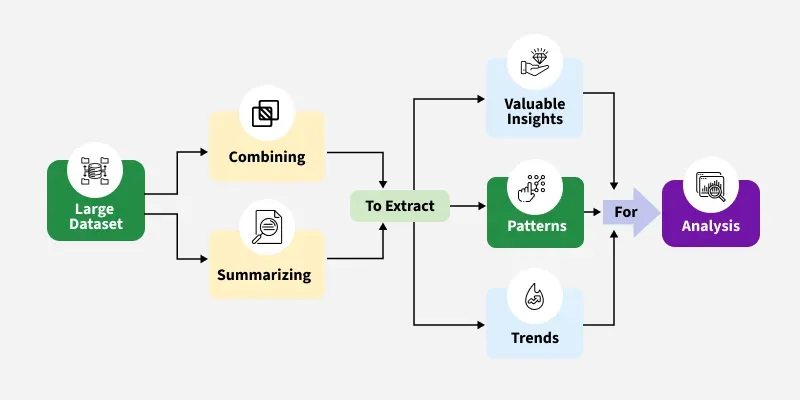
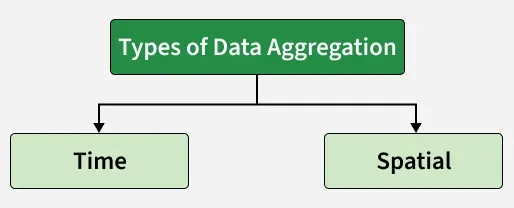
Data Aggregation is used when raw datasets are too detailed for analysis. It summarizes data into meaningful metrics like sum, count, or average to improve insights and user experience. Aggregated data aids in understanding customer behavior, creating reports, and tracing data errors (data lineage). Aggregation can be applied to both numeric and non-numeric data but is always done on groups, not individual records.
Average Customer Age: Helps identify the target age group for a product by calculating the average age instead of analyzing individuals.
Consumers by Country: Counts buyers per country to boost sales where demand is high and improve marketing where it's low.
Online Buyer Behavior: Aggregated data reveals buying patterns and product success, aiding marketing and budgeting decisions.
Voter Turnout: Measures total votes per region, simplifying analysis without tracking individual voter data.
Data aggregators
Data Aggregators are systems in data mining that collects data from numerous sources, then processes the data and repackages them into useful data packages. They play a major role in improving the data of customer by acting as an agent. It helps in the query and delivery process where the customer requests data instances about a certain product. The aggregators provide the customer with matched records of the product. Thereby the customer can buy any instances of matched records.
Working of Data aggregators
The working of data aggregators takes place in three steps:
Data aggregation can also be done by manual method. When one starts a new company, one can opt manual aggregator by using excel sheets and by creating charts to manage performance, budget, marketing etc.
Data aggregation in a well-established company calls the need for middleware, a third party software to implement the data automatically using tools of marketing.
But when large datasets are encountered, a Data Aggregator system is a need to provide accurate results.