|
VOOZH | about |
|
VOOZH | about |
Pre-requisites: Data Mining, Data Warehousing
Data warehousing is the process of collecting, storing, and managing large sets of data from various sources in a single, centralized location for the purpose of reporting and analysis. The goal of data warehousing is to make it easier for organizations to access and analyze their data by bringing it together in one place.
Example:
A retail company might have data on its sales, inventory, customer demographics, and marketing campaigns stored in separate systems. A data warehouse would bring all of this data together in one place, allowing the company to analyze sales by customer demographics, track inventory levels, and measure the effectiveness of marketing campaigns. This would allow the company to make more informed decisions about its operations, such as which products to stock, which marketing strategies to focus on, and how to target its customer base.
Heterogeneous databases are databases that consist of data from multiple, dissimilar sources. These sources may include different types of databases, such as relational databases, NoSQL databases, and flat files, as well as different platforms and operating systems.
Example:
A company might have data on its sales and inventory stored in a relational database, while customer data is stored in a NoSQL database, and financial data is stored in an Excel spreadsheet. By integrating these data sources into a heterogeneous database, the company can analyze sales by customer demographics, track inventory levels, and measure the financial performance of the company all in one place.
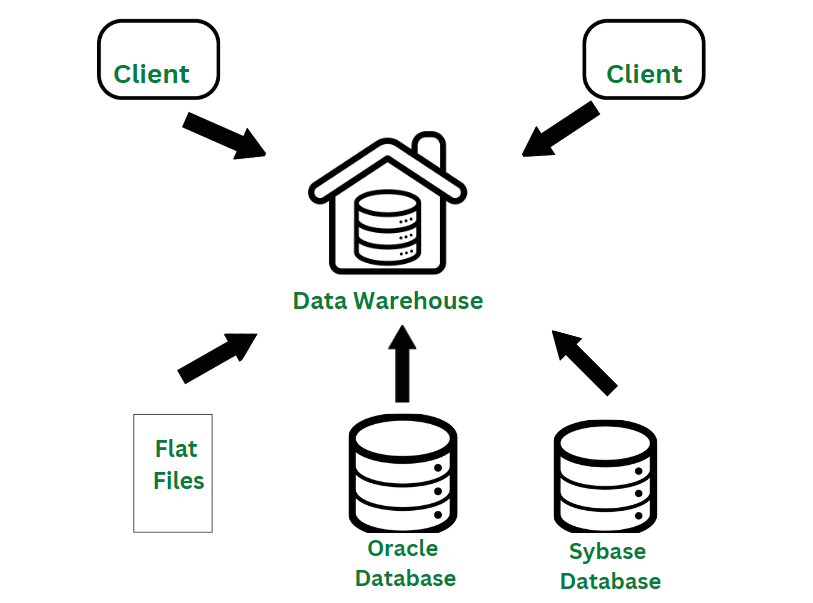
Integration of heterogeneous databases in data warehousing refers to the process of combining data from multiple, disparate databases into a central repository, known as a data warehouse. This process involves extracting data from different sources, such as relational databases, NoSQL databases, and flat files, and then transforming, cleaning, and loading the data into the data warehouse.
The main goal of integrating heterogeneous databases in data warehousing is to make the data from different sources available in a consistent, unified format, allowing for easy querying and analysis of the data. This is particularly useful in organizations that have multiple databases with different structures and data models, as it allows for the integration of data from different systems, applications, and departments.
There are several reasons why the integration of heterogeneous databases is important in data warehousing:
There are two different approaches to integrating heterogeneous databases :
1. Query-Driven Approach:
The query-driven approach for the integration of heterogeneous databases is a method of integrating data from different sources by using a central query processor to handle all data requests. With a query-driven strategy, several sophisticated queries will be created for each separate database. There will therefore be a requirement for filtering and integration of the queries as a query-driven technique will provide complex results. Therefore the query-driven approach is not preferable for the companies as it is an inefficient and expensive approach.
Disadvantages of Query-Driven Approach:
2. Update Driven Approach:
The update-driven approach for the integration of heterogeneous databases in data warehousing is a method of integrating data from multiple databases by periodically updating the data in a central warehouse. The information from several heterogeneous sources is advanced combined and stored in a warehouse in an update-driven method. It is possible to directly query and analyze this saved data. As a result, many businesses utilize the update-driven strategy rather than the query-driven approach for integration because it is more effective and quick.
The update-driven approach has several advantages over the query-driven approach, including:
In conclusion, the integration of heterogeneous databases in data warehousing is a complex task that requires careful planning and execution. It involves several challenges such as data compatibility, data integration, and data consistency. However, the benefits of integrating heterogeneous databases in data warehousing are numerous, such as increased data availability, improved data quality, and enhanced decision-making capabilities.