|
VOOZH | about |
|
VOOZH | about |
In the analysis of algorithms, asymptotic notations are used to evaluate the performance of an algorithm by providing an exact order of growth.
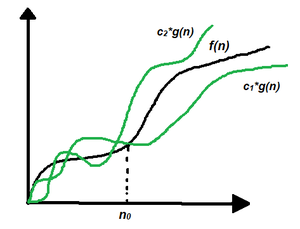
Definition: Let g and f be the function from the set of natural numbers to itself. The function f is said to be Θ(g), if there are constants c1, c2 > 0 and a natural number n0 such that c1* g(n) ≤ f(n) ≤ c2 * g(n) for all n ≥ n0
Θ (g(n)) = {f(n): there exist positive constants c1, c2 and n0 such that 0 ≤ c1 * g(n) ≤ f(n) ≤ c2 * g(n) for all n ≥ n0}
Note: Θ(g) is a set
The above definition means, if f(n) is theta of g(n), then the value f(n) is always between c1 * g(n) and c2 * g(n) for large values of n (n ≥ n0). The definition of theta also requires that f(n) must be non-negative for values of n greater than n0.
In simple language, Big - Theta(Θ) notation specifies asymptotic bounds (both upper and lower) for a function f(n) and provides the
Example: Consider an example to find whether a key exists in an array or not using linear search. The idea is to traverse the array and check every element if it is equal to the key or not.
The pseudo-code is as follows:
bool linearSearch(int a[], int n, int key)
{
 for (int i = 0; i < n; i++) {
 if (a[i] == key)
 return true;
 }
 return false;
}
Below is the implementation of the above approach:
Element is present in array
In a linear search problem, let's assume that all the cases are uniformly distributed (including the case when the key is absent in the array). So, sum all the cases (when the key is present at position 1, 2, 3, ......, n and not present, and divide the sum by n + 1.
Average case time complexity =
⇒
⇒
⇒ (constants are removed)
When to use Big - Θ notation: Big - Θ analyzes an algorithm with most precise accuracy since while calculating Big - Θ, a uniform distribution of different type and length of inputs are considered, it provides the average time complexity of an algorithm, which is most precise while analyzing, however in practice sometimes it becomes difficult to find the uniformly distributed set of inputs for an algorithm, in that case, Big-O notation is used which represent the asymptotic upper bound of a function f.