Applications, Advantages and Disadvantages of Binary Tree
Last Updated : 6 Aug, 2025
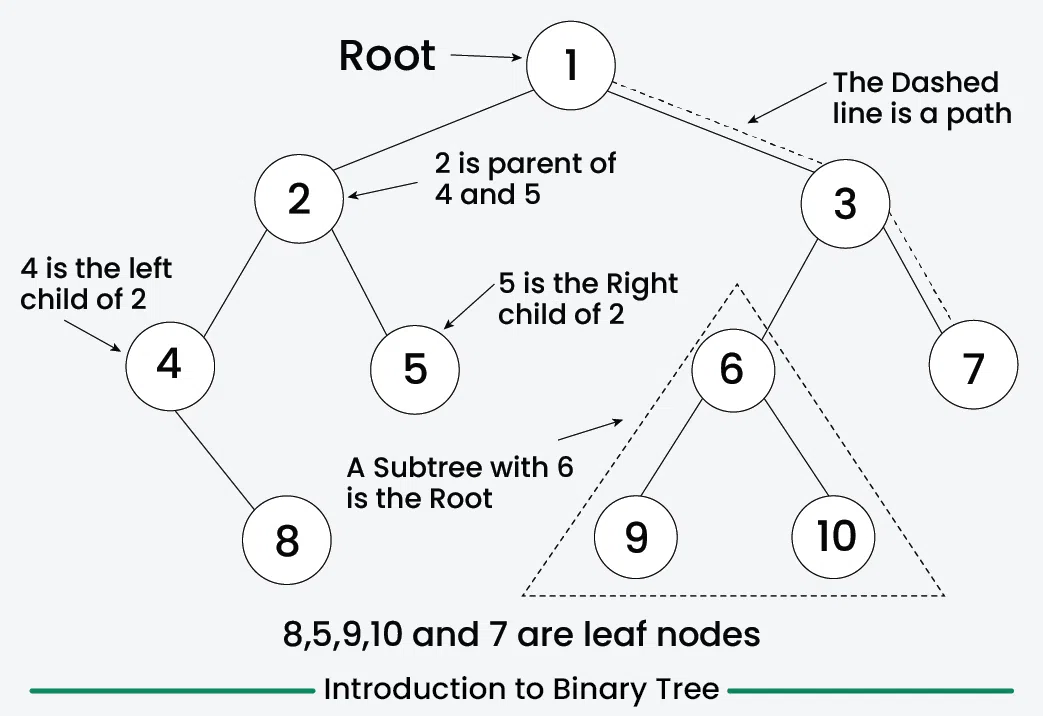
A binary tree is a tree that has at most two children for any of its nodes. There are several types of binary trees. To learn more about them please refer to the article on "Types of binary tree"
Efficient Operations: Enable quick searching, insertion, and deletion (average time complexity: O(log n); AVL and Red-Black Trees maintain this efficiency). Apart from these operations, additional operations like sorted traversal, floor and ceil are also efficient. Please note search, insert and delete are faster than array and linked list and slower than hashing, but hashing does not allow sorted traversal, floor and ceil operations.
Data Structures: Implement associative arrays, maps, and sets while keeping data sorted.
Applications of Binary Heap Trees
Expression Trees: Represent arithmetic expressions where internal nodes are operators and leaf nodes are operands.
Use Cases: Common in compilers and calculators.
Huffman Coding Trees: Essential in data compression (e.g., Huffman coding for lossless compression).