|
VOOZH | about |
|
VOOZH | about |
A heap is a complete binary tree that maintains a specific order, making it ideal for priority-based operations. Heaps are commonly implemented as arrays, where parent-child relationships follow a simple index formula.
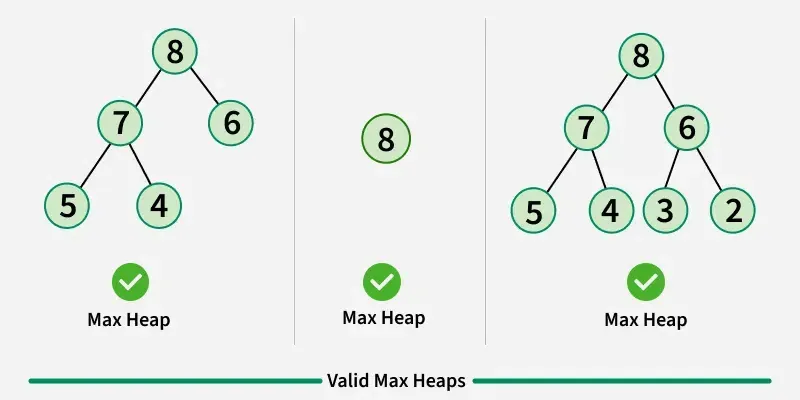
A heap is a complete binary tree that satisfies the heap property: each node’s value is greater than or equal to its children’s values.
Heap comes in two primary forms, each suited for different use cases:
Bothinsertion and deletion in a heap take O(log n) time, where n is the number of elements. This is because after adding or removing an element, the heap may need to be heapified (restructured) up or down to maintain the heap property.
The efficiency really depends on the type of heap you’re using. A heap is designed to give you fast access to one extreme either the smallest or the largest element.
So, heaps are great for one extreme value but not optimized for both.
Heaps are widely used across various domains due to their efficiency in handling prioritized data:
Heaps and BSTs serve distinct purposes despite both being tree based structures:
To convert a Binary Search Tree (BST) into a min-heap or max-heap:
This process takes O(n) time.
To merge two heaps (e.g., two min-heaps or two max-heaps):
The time complexity is O(n), where n is the total number of elements, as build heap is a linear time algorithm.
A heap is a data structure that maintains a specific order (min or max). A priority queue, on the other hand is an abstract data type that allows elements to be processed based on priority. Heaps are one of the most common and efficient ways to implement a priority queue.
Binomial Heap: A collection of binomial trees that allows efficient merging of two heaps in O(log n) time. They are useful when applications require frequent union operations, such as in network optimization problems.
Fibonacci Heap: An advanced heap structure that supports very fast amortized operations. It provides O(1) amortized time for insertion and decrease-key, and O(log n) for deletion. Fibonacci heaps are commonly used in advanced graph algorithms like Dijkstra’s shortest path and Prim’s minimum spanning tree, where decrease-key operations are frequent.
Heap Sort is a comparison-based sorting algorithm that uses a binary heap to organize and sort data efficiently. It works by repeatedly selecting the largest (or smallest) element and placing it in its correct position.
Space Complexity: O(1) for in-place sorting if we do not use recursion in heapify.
The following list of 50 heap coding problems covers a range of difficulty levels, from easy to hard, to help candidates prepare for interviews.
Top 50 Problems on Heap Data Structure asked in SDE Interview