 |
VOOZH | about |
|
VOOZH | about |
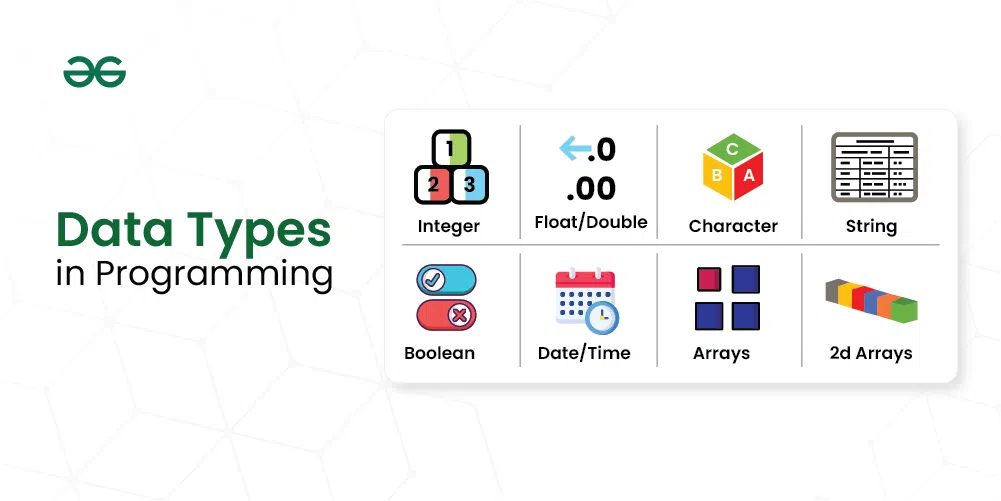
In Programming, data type is an attribute associated with a piece of data that tells a computer system how to interpret its value. Understanding data types ensures that data is collected in the preferred format and that the value of each property is as expected.
Table of Content
An attribute that identifies a piece of data and instructs a computer system on how to interpret its value is called a data type.
The term "data type" in software programming describes the kind of value a variable possesses and the kinds of mathematical, relational, or logical operations that can be performed on it without leading to an error. Numerous programming languages, for instance, utilize the data types string, integer, and floating point to represent text, whole numbers, and values with decimal points, respectively. An interpreter or compiler can determine how a programmer plans to use a given set of data by looking up its data type.
The data comes in different forms. Examples include:
Primitives are predefined data types that are independent of all other kinds and include basic values of particular attributes, like text or numeric values. They are the most fundamental type and are used as the foundation for more complex data types. Most computer languages probably employ some variation of these simple data types.
Composite data types are made up of various primitive kinds that are typically supplied by the user. They are also referred to as user-defined or non-primitive data types. Composite types fall into four main categories: semi-structured (stores data as a set of relationships); multimedia (stores data as images, music, or videos); homogeneous (needs all values to be of the same data type); and tabular (stores data in tabular form).
A user-defined data type (UDT) is a data type that derived from an existing data type. You can use other built-in types already available and create your own customized data types.
Some common primitive datatypes are as follow:
Data Type | Definition | Examples |
|---|---|---|
Integer (int) | represent numeric data type for numbers without fractions |
300, 0 , -300 |
Floating Point (float) | represent numeric data type for numbers with fractions |
34.67, 56.99, -78.09 |
Character (char) | represent single letter, digit, punctuation mark, symbol, or blank space | a , 1, ! |
Boolean (bool) | True or false values | true- 1, false- 0 |
Date | Date in the YYYY-MM-DD format (ISO 8601 syntax) |
2024-01-01 |
Time | Time in the hh:mm:ss format for the time of day, time since an event, or time interval between events |
12:34:20 |
Datetime | Date and time together in the YYYY-MM-DD hh:mm:ss format |
2024 -01-01 12:34:20 |
Some common composite data types are as follow:
Data Type | Definition | Example |
|---|---|---|
String (string) | Sequence of characters, digits, or symbols—always treated as text | hello , ram , i am a girl |
array | List with a number of elements in a specific order—typically of the same type | arr[4]= [0 , 1 , 2 , 3 ] |
pointers | Blocks of memory that are dynamically allocated are managed and stored | *ptr=9 |
Some common user defined data types are as follow:
Data Type | Definition | Example |
|---|---|---|
Enumerated Type (enum) | Small set of predefined unique values (elements or enumerators) that can be text-based or numerical | Sunday -0, Monday -1 |
Structure | allows to combining of data items of different kinds | struct s{ ...} |
Union | contains a group of data objects that can have varied data types | union u {...} |
| Characteristic | Static Typing | Dynamic Typing |
|---|---|---|
| Definition of Data Types | Requires explicit definition of data types | Data types are determined at runtime |
| Type Declaration | Programmer explicitly declares variable types | Type declaration is not required |
| Error Detection | Early error detection during compile time | Errors may surface at runtime |
| Code Readability | Explicit types can enhance code readability | Code may be more concise but less explicit |
| Flexibility | Less flexible as types are fixed at compile time | More flexible, allows variable types to change |
| Compilation Process | Requires a separate compilation step | No separate compilation step needed |
| Example Languages | C, Java, Swift | Python, JavaScript, Ruby |
The process of type casting can be performed in two major types in a C program. These are:
<datatype> variableName = (<datatype>) value;
int value: 54
double value: 54
double value: 54.7
int value: 54
The name of the memory area where data can be stored is called a variable. In a program, variables are used to hold data; they have three properties: name, value, and type. A variable's value may fluctuate while a program is running.
Data type characterizes a variable's attribute; actions also rely on the data type of the variables, as does the data that is stored in variables. The sorts of data that a variable can store are specified by its data types. Numerous built-in data types, including int, float, double, char, and bool, are supported by C programming. Every form of data has a range of values that it can store and a memory usage limit.
Example: Imagine a box labeled "age." You can put a number like 25 in it initially, and later, you might change it to 30. A box labeled "number" is designed for holding numbers (like 42). Another box labeled "name" is designed for holding words or text (like "John"). So, in simple terms, a variable is like a labeled box where you can put things, and the data type is like a tag on the box that tells you what kind of things it can hold. Together, they help the computer understand and manage the information you're working with in a program.
Type safety in a programming language is an abstract construct that enables the language to avoid type errors.
There is an implicit level of type safety in all programming languages. Therefore, the compiler will use the type safety construct to validate types during program compilation, and it will raise an error if we attempt to assign the incorrect type to a variable. Type safety is verified during a program's runtime in addition to during compilation. The type safety feature makes sure that no improper operations are carried out on the underlying object by the code.
Take the machine's 32-bit quantity, for instance. It can be used to represent four ASCII characters, an int, or a floating point. In light of the situation, these interpretations might be accurate. For example, when using assembly, the programmer bears full responsibility for maintaining track of the data types. When a machine-level floating point addition is performed on a 32-bit number that actually represents an integer, the result is indeterminate, which means that the outcomes may vary from computer to computer.
In Conclusion, Programmers can create dependable and efficient code by utilizing data types. Data types can help organizations manage their data more effectively, from collection to integration, in addition to helping programmers write more effective code.

.webp)