for loop provides a concise way of writing the loop structure. Unlike a while loop, a for statement consumes the initialization, condition and increment/decrement in one line thereby providing a shorter, easy to debug structure of looping.
Syntax:
for (initialization condition; testing condition;
 increment/decrement)
{
 statement(s)
}
Flowchart:
👁 Image
Example:
Output:
GFG
GFG
GFG
GFG
GFG
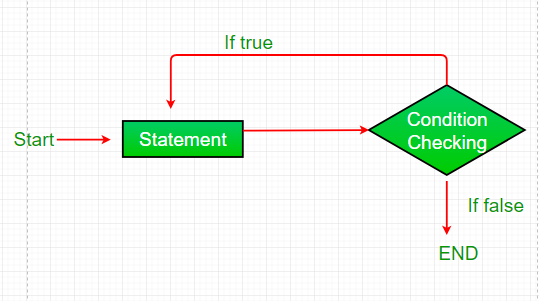
do while loop is similar to while loop with the only difference that it checks for the condition after executing the statements, and therefore is an example of
Exit Control Loop.
Syntax:
do
{
 statements..
}
while (condition);
Flowchart:
👁 do-while
Example:
Output:
GFG
GFG
GFG
GFG
GFG
Here is the difference table:
| For loop |
Do-While loop |
| Statement(s) is executed once the condition is checked. |
Condition is checked after the statement(s) is executed. |
| It might be that statement(s) gets executed zero times. |
Statement(s) is executed at least once. |
| For the single statement, bracket is not compulsory. |
Brackets are always compulsory. |
| Initialization may be outside or in condition box. |
Initialization may be outside or within the loop. |
| for loop is entry controlled loop. |
do-while is exit controlled loop. |
| for ( init ; condition ; iteration )
{ statement (s); } |
do { statement(s); }
while (condition); |