|
VOOZH | about |
|
VOOZH | about |
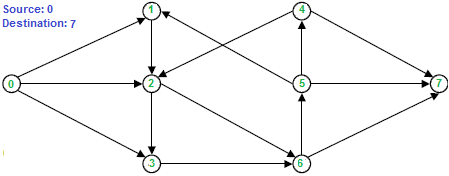
Given a directed graph and two vertices in it, source 's' and destination 't', find out the maximum number of edge disjoint paths from s to t. Two paths are said edge disjoint if they don't share any edge.
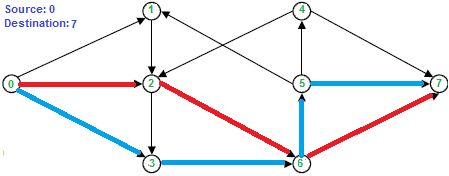
There can be maximum two edge disjoint paths from source 0 to destination 7 in the above graph. Two edge disjoint paths are highlighted below in red and blue colors are 0-2-6-7 and 0-3-6-5-7.
Note that the paths may be different, but the maximum number is same. For example, in the above diagram, another possible set of paths is 0-1-2-6-7 and 0-3-6-5-7 respectively.
This problem can be solved by reducing it to maximum flow problem. Following are steps.
- Consider the given source and destination as source and sink in flow network. Assign unit capacity to each edge.
- Run Ford-Fulkerson algorithm to find the maximum flow from source to sink.
- The maximum flow is equal to the maximum number of edge-disjoint paths.
When we run Ford-Fulkerson, we reduce the capacity by a unit. Therefore, the edge can not be used again. So the maximum flow is equal to the maximum number of edge-disjoint paths.
Following is the implementation of the above algorithm. Most of the code is taken from here.
There can be maximum 2 edge-disjoint paths from 0 to 7
Time Complexity : O(|V| * E2) ,where E is the number of edges and V is the number of vertices.
Space Complexity :O(V) ,as we created queue.
Time Complexity: Same as time complexity of Edmonds-Karp implementation of Ford-Fulkerson (See time complexity discussed here)