|
VOOZH | about |
|
VOOZH | about |
Prerequisites: Minimax Algorithm in Game Theory, Evaluation Function in Game Theory
Let us combine what we have learnt so far about minimax and evaluation function to write a proper Tic-Tac-Toe AI (Artificial Intelligence) that plays a perfect game. This AI will consider all possible scenarios and makes the most optimal move.
We shall be introducing a new function called findBestMove(). This function evaluates all the available moves using minimax() and then returns the best move the maximizer can make. The pseudocode is as follows :
function findBestMove(board):
 bestMove = NULL
 for each move in board :
 if current move is better than bestMove
 bestMove = current move
 return bestMove
To check whether or not the current move is better than the best move we take the help of minimax() function which will consider all the possible ways the game can go and returns the best value for that move, assuming the opponent also plays optimally
The code for the maximizer and minimizer in the minimax() function is similar to findBestMove(), the only difference is, instead of returning a move, it will return a value. Here is the pseudocode :
function minimax(board, depth, isMaximizingPlayer):

 if current board state is a terminal state :
 return value of the board

 if isMaximizingPlayer :
 bestVal = -INFINITY
 for each move in board :
 value = minimax(board, depth+1, false)
 bestVal = max( bestVal, value)
 return bestVal

 else :
 bestVal = +INFINITY
 for each move in board :
 value = minimax(board, depth+1, true)
 bestVal = min( bestVal, value)
 return bestVal
To check whether the game is over and to make sure there are no moves left we use isMovesLeft() function. It is a simple straightforward function which checks whether a move is available or not and returns true or false respectively. Pseudocode is as follows :
function isMovesLeft(board):
 for each cell in board:
 if current cell is empty:
 return true
 return false
One final step is to make our AI a little bit smarter. Even though the following AI plays perfectly, it might choose to make a move which will result in a slower victory or a faster loss. Lets take an example and explain it.
Assume that there are 2 possible ways for X to win the game from a given board state.
Our evaluation function will return a value of +10 for both moves A and B. Even though the move A is better because it ensures a faster victory, our AI may choose B sometimes. To overcome this problem we subtract the depth value from the evaluated score. This means that in case of a victory it will choose a the victory which takes least number of moves and in case of a loss it will try to prolong the game and play as many moves as possible. So the new evaluated value will be
Now since move A has a higher score compared to move B our AI will choose move A over move B. The same thing must be applied to the minimizer. Instead of subtracting the depth we add the depth value as the minimizer always tries to get, as negative a value as possible. We can subtract the depth either inside the evaluation function or outside it. Anywhere is fine. I have chosen to do it outside the function. Pseudocode implementation is as follows.
if maximizer has won:
 return WIN_SCORE – depth

else if minimizer has won:
 return LOOSE_SCORE + depth
Below is implementation of above idea.
Output :
The value of the best Move is : 10

The Optimal Move is :
ROW: 2 COL: 2
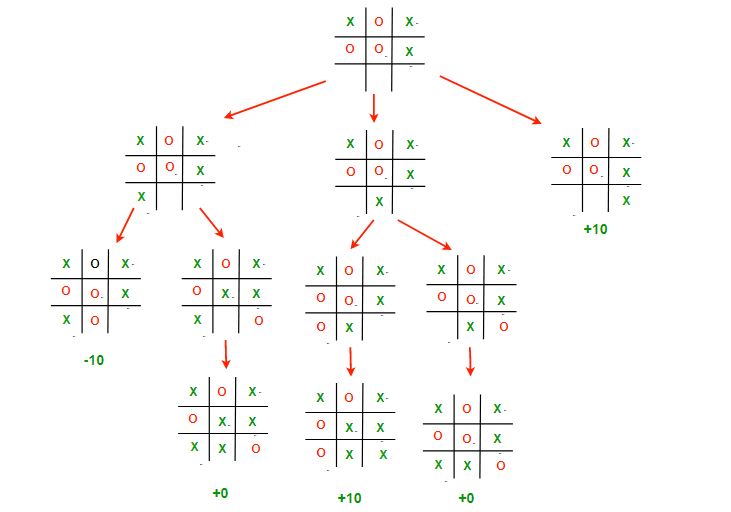
This image depicts all the possible paths that the game can take from the root board state. It is often called the Game Tree.
The 3 possible scenarios in the above example are :
Remember, even though X has a possibility of winning if he plays the middle move, O will never let that happen and will choose to draw instead.
Therefore the best choice for X, is to play [2,2], which will guarantee a victory for him.
We do encourage our readers to try giving various inputs and understanding why the AI choose to play that move. Minimax may confuse programmers as it thinks several moves in advance and is very hard to debug at times. Remember this implementation of minimax algorithm can be applied any 2 player board game with some minor changes to the board structure and how we iterate through the moves. Also sometimes it is impossible for minimax to compute every possible game state for complex games like Chess. Hence we only compute upto a certain depth and use the evaluation function to calculate the value of the board.
Stay tuned for next weeks article where we shall be discussing about Alpha-Beta pruning that can drastically improve the time taken by minimax to traverse a game tree.