|
VOOZH | about |
|
VOOZH | about |
The Ford-Fulkerson algorithm is a widely used algorithm to solve the maximum flow problem in a flow network. The maximum flow problem involves determining the maximum amount of flow that can be sent from a source vertex to a sink vertex in a directed weighted graph, subject to capacity constraints on the edges.
The algorithm works by iteratively finding an augmenting path, which is a path from the source to the sink in the residual graph, i.e., the graph obtained by subtracting the current flow from the capacity of each edge. The algorithm then increases the flow along this path by the maximum possible amount, which is the minimum capacity of the edges along the path.
Problem:
Given a graph which represents a flow network where every edge has a capacity. Also, given two vertices source ‘s’ and sink ‘t’ in the graph, find the maximum possible flow from s to t with the following constraints:
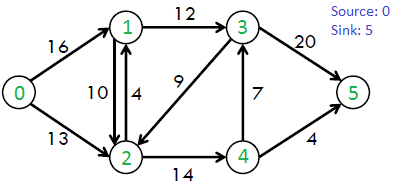
For example, consider the following graph from the CLRS book.
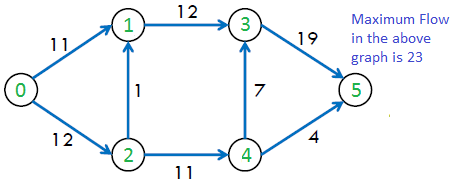
The maximum possible flow in the above graph is 23.
Ford-Fulkerson Algorithm in Python
The following is simple idea of Ford-Fulkerson algorithm:
Below is the implementation of Ford-Fulkerson algorithm. To keep things simple, graph is represented as a 2D matrix.
The maximum possible flow is 23
Time Complexity: Time complexity of the above algorithm is O(max_flow * E). We run a loop while there is an augmenting path. In worst case, we may add 1 unit flow in every iteration. Therefore the time complexity becomes O(max_flow * E).