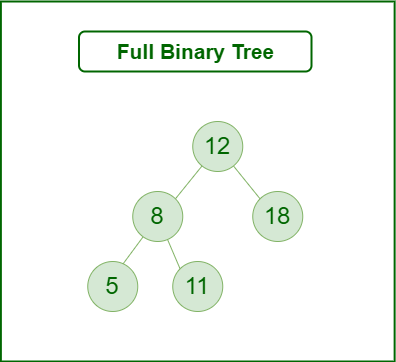
A full binary tree is a binary tree with either zero or two child nodes for each node. A full binary does not have any nodes that have only one child node.
👁 Image Full Binary Tree Full Binary Tree Theorem: Let T be a nonempty, full binary tree Then:
If T has I internal nodes, the number of leaves is L = I + 1 . This is known as the full binary tree theorem.
Facts derived from the theorem:
If T has I internal nodes, the total number of nodes is N = 2I + 1 . If T has a total of N nodes, the number of internal nodes is I = (N – 1)/2 . If T has a total of N nodes, the number of leaves is L = (N + 1)/2. If T has L leaves, the total number of nodes is N = 2L – 1 . If T has L leaves, the number of internal nodes is I = L – 1 . Some other properties: There are a maximum of 2 k nodes in level k for every k >= 0. The binary tree with λ levels has maximum of 2 λ -1 nodes. The binary tree with N nodes has at least [log 2 (N + 1)] levels. The binary tree with L leaves has at least [log 2 L] + 1 levels . Related Articles: