|
VOOZH | about |
|
VOOZH | about |
In-place has more than one definition. One strict definition is.
An in-place algorithm is an algorithm that does not need an extra space and produces an output in the same memory that contains the data by transforming the input 'in-place'. However, a small constant extra space used for variables is allowed.
A more broad definition is,
In-place means that the algorithm does not use extra space for manipulating the input but may require a small though non-constant extra space for its operation. Usually, this space is O(log n), though sometimes anything in O(n) (Smaller than linear) is allowed.
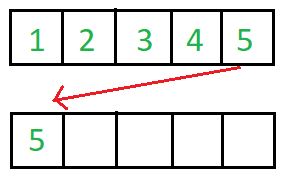
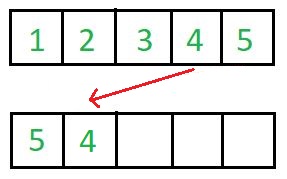
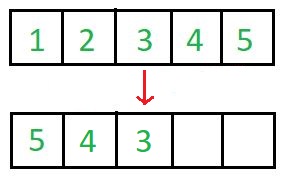
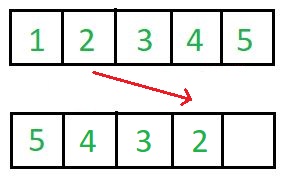
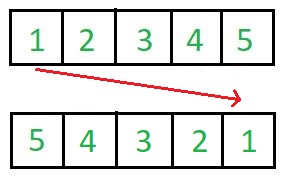
A Not In-Place Implementation of reversing an array
Implementation:
1 2 3 4 5 6
Reversed array is
6 5 4 3 2 1
Time Complexity: O(n)
This needs O(n) extra space and is an example of a not-in-place algorithm.
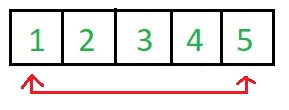
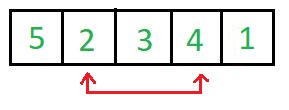
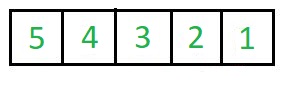
An In-Place Implementation of Reversing an array.
Implementation:
1 2 3 4 5 6
Reversed array is
6 5 4 3 2 1
Time Complexity: O(n)
This needs O(1) extra space for exchanging elements and is an example of an in-place algorithm.
Which Sorting Algorithms are In-Place and which are not?
In Place: Bubble sort, Selection Sort, Insertion Sort, Heapsort.
Not In-Place: Merge Sort. Note that merge sort requires O(n) extra space.
What about QuickSort? Why is it called In-Place?
QuickSort uses extra space for recursive function calls. It is called in-place according to broad definition as extra space required is not used to manipulate input, but only for recursive calls.