|
VOOZH | about |
|
VOOZH | about |
Introsort(Introspective sort) is a comparison based sort that consists of three sorting phases. They are Quicksort, Heapsort, and Insertion sort. Basic concepts of Introsort and the C++ code are available here
The following section shows how the Introsort algorithm is formulated, after reviewing the pros and cons of the respective algorithms.
Here is how Introsort is formulated:
Choosing the right sorting algorithm depends on the occasion where the sorting algorithm is being used. There are a good number of sorting algorithms in hand already that has pros and cons of its own. So, to get a better sorting algorithm, the solution is to tweak the existing algorithms and produce a new sorting algorithm that works better. There are a lot of hybrid algorithms, that outperforms the general sorting algorithms. One such is the Introsort. The best versions of Quicksort are competitive with both heap sort and merge sort on the vast majority of inputs. Rarely Quicksort has the worst case of O(N ^ 2) running time and O(N) stack usage. Both Heapsort and Mergesort have O(N log N) worst-case running time, together with a stack usage of O(1) for Heapsort and O(log N) for Mergesort respectively. Also, Insertion sort performs better than any of the above algorithms if the data set is small.
Combining all the pros of the sorting algorithms, Introsort behaves based on the data set.
How does depthLimit work?
depthLimit represents maximum depth for recursion. It is typically chosen as log of length of input array (please refer below implementation). The idea is to ensure that the worst case time complexity remains O(N log N). Note that the worst-case time complexity of HeapSort is O(N log N).
Why is Mergesort not used?
As the arrays are being dealt with the in-place concept where Quicksort outperforms Mergesort, we are not using Mergesort.
Can Introsort be applied everywhere?
Is Introsort the only hybrid sorting algorithm?
No. There are other hybrid sorting algorithms like Hybrid Mergesort, Tim sort, Insertion-Merge hybrid.
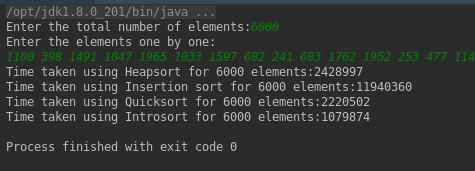
Comparison of Heapsort, Insertion sort, Quicksort, Introsort while sorting 6000 elements(in milliseconds).
Pseudocode:
sort(A : array):
 depthLimit = 2xfloor(log(length(A)))
 introsort(A, depthLimit)

introsort(A, depthLimit):
 n = length(A)
 if n<=16:
 insertionSort(A)
 if depthLimit == 0:
 heapsort(A)
 else:

 // using quick sort, the
 // partition point is found
 p = partition(A)
 introsort(A[0:p-1], depthLimit - 1)
 introsort(A[p+1:n], depthLimit - 1)
Time Complexity:
Worst-case performance: O(nlogn) (better than Quicksort)
Average-case performance: O(nlogn)
In the Quicksort phase, the pivot can either be chosen using the median-of-3 concept or last element of the array. For data that has a huge number of elements, median-of-3 concept slows down the running time of the Quicksort.
In the example described below, the quicksort algorithm calculates the pivot element based on the median-of-3 concept.
Example:
0 2 2 2 3 4 4 8 8 8 9 10 10 10 11 13 13 13 16 18 22 22 23 24 24 27 27 28 28 28