|
VOOZH | about |
|
VOOZH | about |
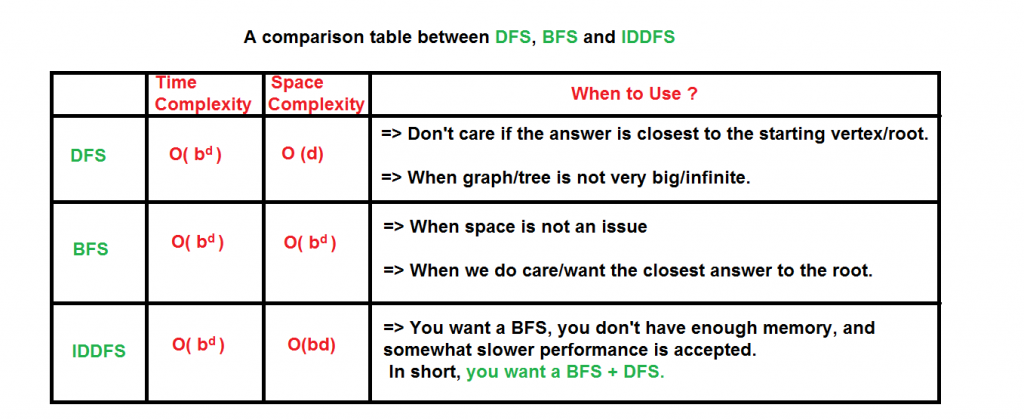
There are two common ways to traverse a graph, BFS and DFS. Considering a Tree (or Graph) of huge height and width, both BFS and DFS are not very efficient due to following reasons.
IDDFS combines depth-first search's space-efficiency and breadth-first search's fast search (for nodes closer to root).
How does IDDFS work?
IDDFS calls DFS for different depths starting from an initial value. In every call, DFS is restricted from going beyond given depth. So basically we do DFS in a BFS fashion.
Algorithm:
// Returns true if target is reachable from
// src within max_depth
bool IDDFS(src, target, max_depth)
for limit from 0 to max_depth
if DLS(src, target, limit) == true
return true
returnfalse

bool DLS(src, target, limit)
if (src == target)
returntrue;

 // If reached the maximum depth,
 // stop recursing.
if (limit <= 0)
returnfalse;

foreach adjacent i of src
if DLS(i, target, limit-1)
returntrue

returnfalse
An important thing to note is, we visit top level nodes multiple times. The last (or max depth) level is visited once, second last level is visited twice, and so on. It may seem expensive, but it turns out to be not so costly, since in a tree most of the nodes are in the bottom level. So it does not matter much if the upper levels are visited multiple times. Below is implementation of above algorithm
Target is reachable from source within max depth
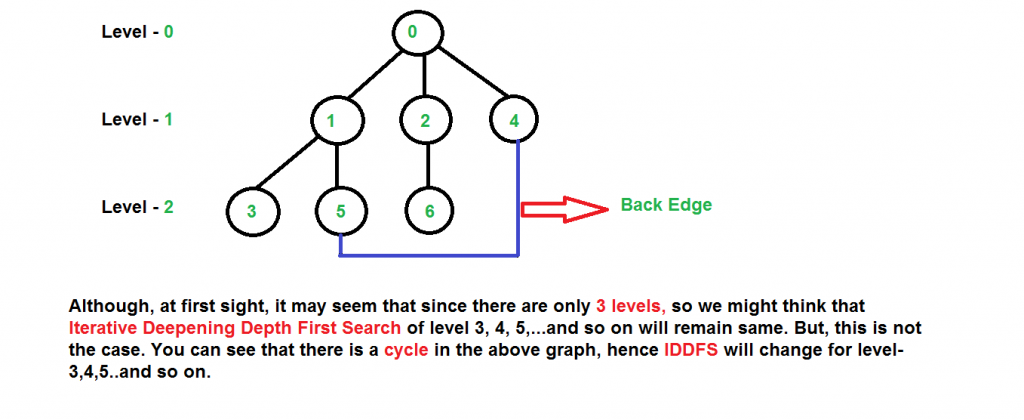
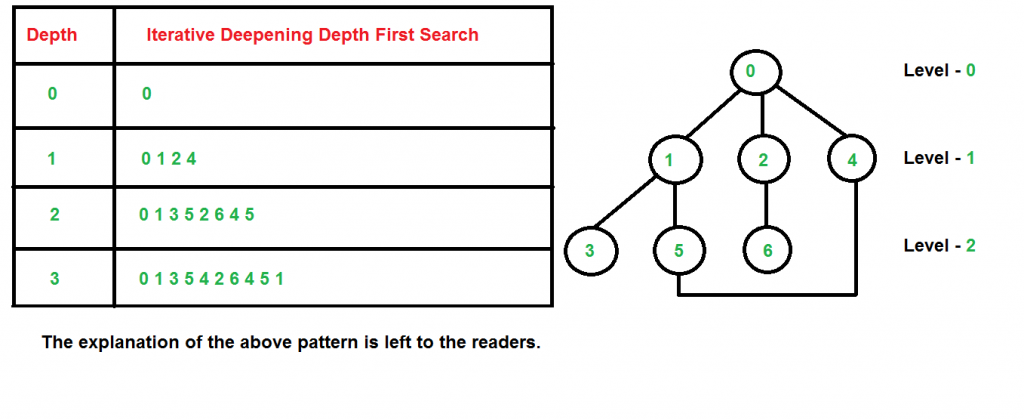
Illustration: There can be two cases:
Time Complexity: Suppose we have a tree having branching factor 'b' (number of children of each node), and its depth 'd', i.e., there are bd nodes. In an iterative deepening search, the nodes on the bottom level are expanded once, those on the next to bottom level are expanded twice, and so on, up to the root of the search tree, which is expanded d+1 times. So the total number of expansions in an iterative deepening search is-
 (d)b + (d-1)b2 + .... + 3bd-2 + 2bd-1 + bd

That is,
 Summation[(d + 1 - i) bi], from i = 0 to i = d
Which is same as O(bd)
After evaluating the above expression, we find that asymptotically IDDFS takes the same time as that of DFS and BFS, but it is indeed slower than both of them as it has a higher constant factor in its time complexity expression. IDDFS is best suited for a complete infinite tree
Time: O(b^d)
Space: O(d)