|
VOOZH | about |
|
VOOZH | about |
Segment tree is introduced in previous post with an example of range sum problem. We have used the same "Sum of given Range" problem to explain Lazy propagation
How does update work in Simple Segment Tree?
In the previous post, update function was called to update only a single value in array. Please note that a single value update in array may cause multiple updates in Segment Tree as there may be many segment tree nodes that have a single array element in their ranges.
Below is simple logic used in previous post.
1) Start with root of segment tree.
2) If array index to be updated is not in current node's range, then return
3) Else update current node and recur for children.
Below is code taken from previous post.
What if there are updates on a range of array indexes?
For example add 10 to all values at indexes from 2 to 7 in array. The above update has to be called for every index from 2 to 7. We can avoid multiple calls by writing a function updateRange() that updates nodes accordingly.
Lazy Propagation - An optimization to make range updates faster
When there are many updates and updates are done on a range, we can postpone some updates (avoid recursive calls in update) and do those updates only when required.
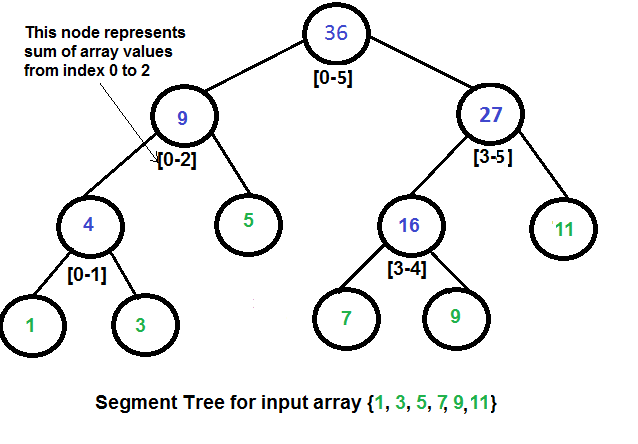
Please remember that a node in segment tree stores or represents result of a query for a range of indexes. And if this node's range lies within the update operation range, then all descendants of the node must also be updated. For example consider the node with value 27 in above diagram, this node stores sum of values at indexes from 3 to 5. If our update query is for range 2 to 5, then we need to update this node and all descendants of this node. With Lazy propagation, we update only node with value 27 and postpone updates to its children by storing this update information in separate nodes called lazy nodes or values. We create an array lazy[] which represents lazy node. Size of lazy[] is same as array that represents segment tree, which is tree[] in below code.
The idea is to initialize all elements of lazy[] as 0. A value 0 in lazy[i] indicates that there are no pending updates on node i in segment tree. A non-zero value of lazy[i] means that this amount needs to be added to node i in segment tree before making any query to the node.
Below is modified update method.
// To update segment tree for change in array
// values at array indexes from us to ue.
updateRange(us, ue)
1) If current segment tree node has any pending
 update, then first add that pending update to
 current node.
2) If current node's range lies completely in
 update query range.
....a) Update current node
....b) Postpone updates to children by setting
 lazy value for children nodes.
3) If current node's range overlaps with update
 range, follow the same approach as above simple
 update.
...a) Recur for left and right children.
...b) Update current node using results of left
 and right calls.
Is there any change in Query Function also?
Since we have changed update to postpone its operations, there may be problems if a query is made to a node that is yet to be updated. So we need to update our query method also which is getSumUtil in previous post. The getSumUtil() now first checks if there is a pending update and if there is, then updates the node. Once it makes sure that pending update is done, it works same as the previous getSumUtil().
Below are programs to demonstrate working of Lazy Propagation.
Output:
Sum of values in given range = 15
Updated sum of values in given range = 45
Time Complexity: O(n)
Auxiliary Space: O(MAX)
Related Topic: Segment Tree