Prerequisites - FIFO (First-In-First-Out) approach in Programming, FIFO vs LIFO approach in Programming
LIFO is an abbreviation for last in, first out. It is a method for handling data structures where the first element is processed last and the last element is processed first.
Real-life example:
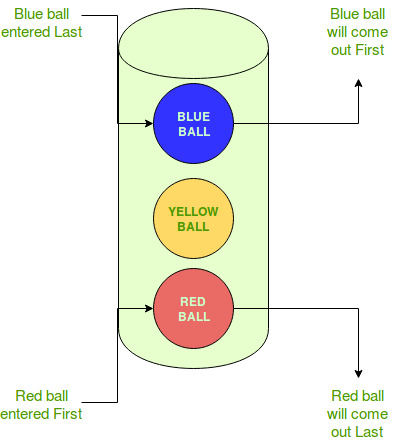
👁 Image
In this example, following things are to be considered:
- There is a bucket that holds balls.
- Different types of balls are entered into the bucket.
- The ball to enter the bucket last will be taken out first.
- The ball entering the bucket next to last will be taken out after the ball above it (the newer one).
- In this way, the ball entering the bucket first will leave the bucket last.
- Therefore, the Last ball (Blue) to enter the bucket gets removed first and the First ball (Red) to enter the bucket gets removed last.
This is known as Last-In-First-Out approach or LIFO.
Where is LIFO used:
- Data Structures:
Certain data structures like Stacks and other variants of Stacks use LIFO approach for processing data. - Extracting latest information:
Sometimes computers use LIFO when data is extracted from an array or data buffer. When it is required to get the most recent information entered, the LIFO approach is used.
Program Examples for LIFO:
Implementation: Using Stack data structure.
OutputPop :4
3
2
1
0
Element on stack top : 4
Element is found at position 3
Element not found
Complexity Analysis:
- Time Complexity: O(n)
- Auxiliary Space: O(n)