Minimum nodes to be removed to make a Binary tree complete
Last Updated : 23 Jul, 2025
Given a binary tree with positive values of nodes, find the minimum number of nodes that need to be removed to transform it into a complete binary tree. Return 0 if the given tree is already complete.
Note: A complete binary tree is a special type of binary tree where all the levels of the tree are filled completely except possibly the lowest level nodes which are filled from as left as possible.
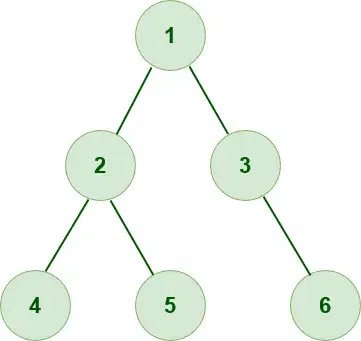
Output: 1 Explanation: If we remove node 6, it will transform into the complete binary tree. Note that we could also remove all the nodes of the last level which will also convert it to complete but it will not be the minimum.
Using BFS (Breadth First Search): BFS is the most intuitive algorithm here. We will traverse through each level of the given binary tree and when we find the first null node after that all other nodes have to be removed (if present) to convert it to a complete binary tree, So we will count those nodes and return it as our answer.
Steps that were to follow the above approach:
Start the BFS traversal with the root node.
To keep track of the null node create a boolean "nullFound" with starting value of false.
Now when the first null node is found make "nullFound" true.
As soon as "nullFound" becomes true, count all preceding nodes of the same level as well as of below levels.
Below is the code to implement the above steps:
Output
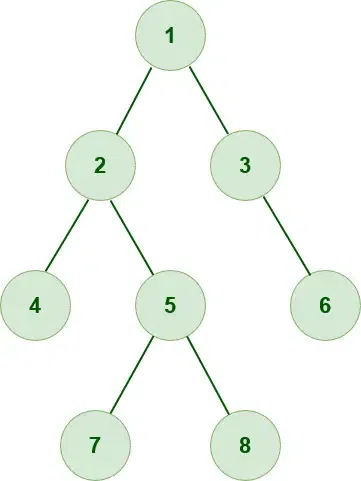
Minimum number of nodes to be removed to make the tree complete is: 3
Time Complexity: O(n), (n is the number of nodes) because we are traversing through all the nodes. Auxiliary Space: O(n), (n is the number of nodes) queue is used to contain all the nodes.
Approach:
Using DFS (Depth First Search): Using DFS for this problem is a little bit tricky. We can not directly check, at which level the first null node is found as in the above approach. So we will create an array and store the elements of the given tree (level-wise) in it, at a specific index such that if the tree was complete all the nodes would be filled in the array before a null appears. After the first null node is found the count of all the preceding nodes is our answer.