|
VOOZH | about |
|
VOOZH | about |
Precomputation refers to the process of pre-calculating and storing the results of certain computations or data structures in advance, in order to speed up the execution time of a program. This can be useful in situations where the same calculations or data structures are needed multiple times, as it avoids the need to recalculate them every time.
Time-Space Trade-Off during Pre-Computation: In order to reduce the amount of time, pre-computation relies on quickly accessing the pre-existing data. We need to store that data in some sort of data structure, hence the Auxiliary space requirement increases.
A variety of questions in competitive programming requires printing solution for each Query. Test cases are designed in such a way that if a programmer computes solution again and again for each query then it may result in TLE (Time Limit Exceed).
Pre-Computation allows to store a part of solution before processing the queries and then for each query instead of calculating the solution we just need to retrieve that solution.For example, let's say you have Q queries and each query requires to traverse an array of size N, this will result in a time complexity of O(Q*N), imagine if we can precompute and store the data in O(N) time and then process each query in O(1) time, then we can clearly see that the complexity drastically drops to O(max(Q,N)).
: We have an array arr[] of size N and for T number of test cases we want to get the following information in O(1)
- Sum/ Xor/ Product of all elements of array from index L to R.
- Next Greater/Smaller Element on Left for any index 'i'
- Minimum/Maximum element on the left of any index 'i'.
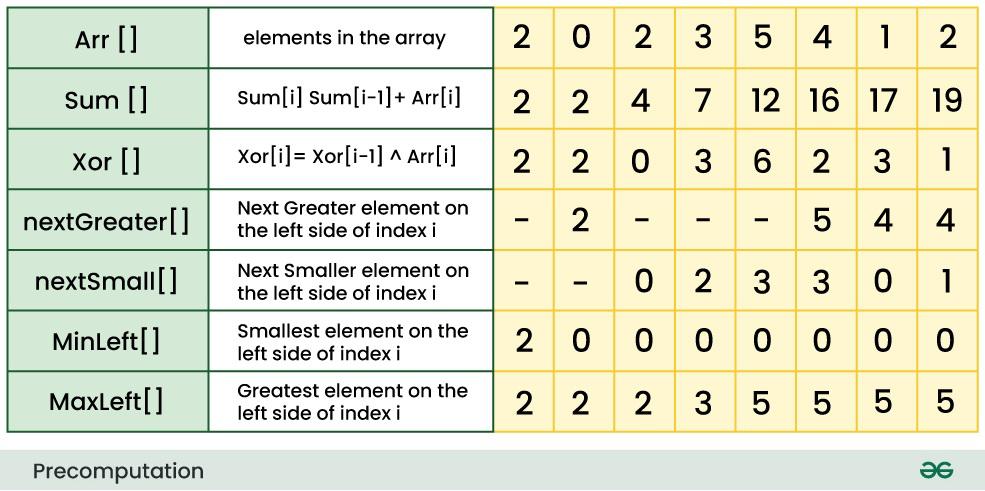
: Before processing the test cases we can precompute the required data in O(N) as follows:
👁 PrecomputationUsing the above table we can calcultate our requirement in O(1) as:
- Sum of elements from index L to R = Sum[R]- Sum[L-1]
- Xor of elements from index L to R = Xor[R]- Xor[L-1]
- Next Greater element on left of i = nextGreater[i]
- Next Smaller element on left of i = nextSmall[i]
- Smallest element on left of i = MinLeft[i]
- Greatest element on left of i = MaxLeft[i]
Click here to expand your knowledge about Prefix/Suffix Arrays:
Code Snippet forPre-Computation:
Let assume, there are Q queries and for each query we have to check if a number is Prime or not.
Brute force: For each query we can check if a number n is prime or not in
Optimal approach: Use sieve of eratosthenes to store the Primality in O(Nlog(logN)) and for each query we can check if a number is prime or not in O(1)
Complexity Analysis:
Code Snippet of check if a number is prime in O(1):
Lets assume, there are 'Q' queries and for each query we want to get smallest prime factor of a number 'n'.
Brute force: For each query we can get first prime factor of n in
Optimal approach: Use sieve of eratosthenes to store the Primality in O(Nlog(logN)) and for each query we can check if a number is prime or not in O(1)
Complexity Analysis:
Code Snippet to get smallest prime factor of a number in O(1):
Lets assume, We have T number of test cases and for each test case we want to get FATORIAL , INVERSE FACTORIAL for a number 'n' , also we want calculate to calculate nCr in O(1)
Brute Force: For each test case we can calculate the above requirements in O(N) for a number N.
Optimal approach:
Complexity Analysis:
Code Snippet to to compute nCr in O(1):
Lets assume, We have a string S and Q queries, for each query we want to get the number of occurance of a character in index range L to R.
Brute Force: For each query we can iterate the string from index L to R to know the occurance of desired character in O(N)
Pre-computation approach: We can precompute a 2-D prefix array pSum[][] such that pSum[i][j] stores the number of occurences of j'th aphabet till index i. To compute our require we can use the following formula:
Code Snippet of Pre-Computation On Strings:
Pre-Computation on trees mainly rely on a node storing information about its subtree, this allows the tree traversal to skip certain nodes and hence reduces the complexity to the height of he tree in most of the cases.
Below data can be pre-computed in case of a tree:
Problem | Difficulty |
|---|---|
Easy | |
Easy | |
Easy | |
Easy | |
Check in binary array the number represented by a subarray is odd or even | Easy |
Easy | |
Medium | |
Medium | |
Medium | |
Medium | |
Medium | |
Medium | |
Print modified array after multiple array range increment operations | Medium |
Hard | |
Range Minimum Query (Square Root Decomposition and Sparse Table) | Hard |
Range Query on array whose each element is XOR of index value and previous element | Hard |
Queries for GCD of all numbers of an array except elements in a given range | Hard |
Hard |