|
VOOZH | about |
|
VOOZH | about |
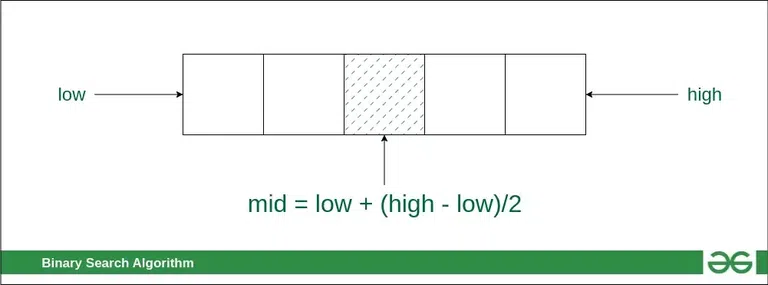
The most common method to calculate mid or middle element index in Binary Search Algorithm is to find the middle of the highest index and lowest index of the searchable space, using the formula mid = low + \frac{(high - low)}{2}
Consider the following implementation of the Binary Search function:
The above code looks fine except for one subtle thing, the expression
mid = (low + high)/2.
It fails for large values of low and high. Specifically, it fails if the sum of low and high is greater than the maximum positive value of int data type (i.e., 231 - 1). The sum overflows to a negative value, and the value stays negative when divided by two. This causes an array index out of bounds with unpredictable results.
The following is one way:
int mid = low + ((high - low) / 2);
Probably faster, and arguably as clear is (works only in Java, refer this):
int mid = (low + high) >>> 1;
In C and C++ (where you don't have the >>> operator), you can do this:
mid = ((unsigned int)low + (unsigned int)high)) >> 1
A similar problem appears in other similar types of divide and conquer algorithms like Merge Sort as well. The above problem occurs when values of low and high are such that their sum is greater than the permissible limit of the data type. Although, this much size of an array is not likely to appear most of the time.