|
VOOZH | about |
|
VOOZH | about |
Given a decimal number as input, we need to write a program to convert the given decimal number into an equivalent hexadecimal number. i.e. convert the number with base value 10 to base value 16.
Hexadecimal numbers use 16 values to represent a number. Numbers from 0-9 are expressed by digits 0-9 and 10-15 are represented by characters from A - F.
Examples:
Input : 116
Output: 74Input : 10
Output: AInput : 33
Output: 21
Algorithm:
Example
If the given decimal number is 2545.
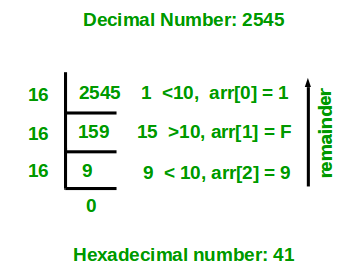
Step 1: Calculate the remainder when 2545 is divided by 16 is 1. Therefore, temp = 1. As temp is less than 10. So, arr[0] = 48 + 1 = 49 = '1'.
Step 2: Divide 2545 by 16. The new number is 2545/16 = 159.
Step 3: Calculate the remainder when 159 is divided by 16 is 15. Therefore, temp = 15. As temp is greater than 10. So, arr[1] = 55 + 15 = 70 = 'F'.
Step 4: Divide 159 by 16. The new number is 159/16 = 9.
Step 5: Calculate the remainder when 9 is divided by 16 is 9. Therefore, temp = 9. As temp is less than 10. So, arr[2] = 48 + 9 = 57 = '9'.
Step 6: Divide 9 by 16. The new number is 9/16 = 0.
Step 7: Since the number becomes = 0. Stop repeating steps and print the array in reverse order. Therefore, the equivalent hexadecimal number is 9F1.
The below diagram shows an example of converting the decimal number 2545 to an equivalent hexadecimal number.
Below is the implementation of the above idea.
9F1
Time complexity: O(log16n)
Auxiliary space: O(1)
Using Predefined function
9f1
Time Complexity: O(log16(n)), because we divide the n by 16 till it becomes zero.
Auxiliary Space: O(1), we cannot use any extra space.