|
VOOZH | about |
|
VOOZH | about |
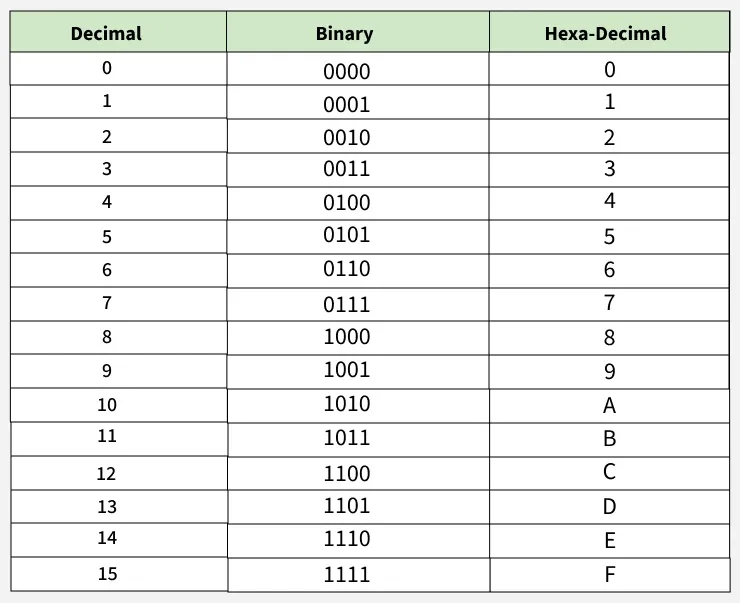
The Hexadecimal system is a base-16 number system that plays an important role in computing and digital systems. It uses sixteen symbols to represent values:
Digits (0 to 9) and the letters A to F, where A = 10, B = 11, and so on up to F = 15.
The numbers in the hexadecimal number system have weightage in powers of 16. The power of 16 increases as the digit is shifted towards the left of the number. This is explained by the example as,
Example: (AB12)16
Place value of each digit in (AB12)16 is,
= A×163 + B×162 + 1×161 + 2×160
Conversion of a number system means conversion from one base to another. The following are the conversions of the Hexadecimal Number System to other Number Systems:
To convert a hexadecimal number to decimal (base-10), multiply each digit by its corresponding power of 16 and sum the results.
Example: To convert (8EB4)16 into a decimal value
Follow the steps given below:
- Step 1: Write the decimal values of the symbols used in the Hex number i.e. from A-F
- Step 2: Multiply each digit of the Hex number with its place value. Starting from right to left i.e. LSB to MSB.
- Step 3: Add the result of multiplication and the final sum will be the decimal number.
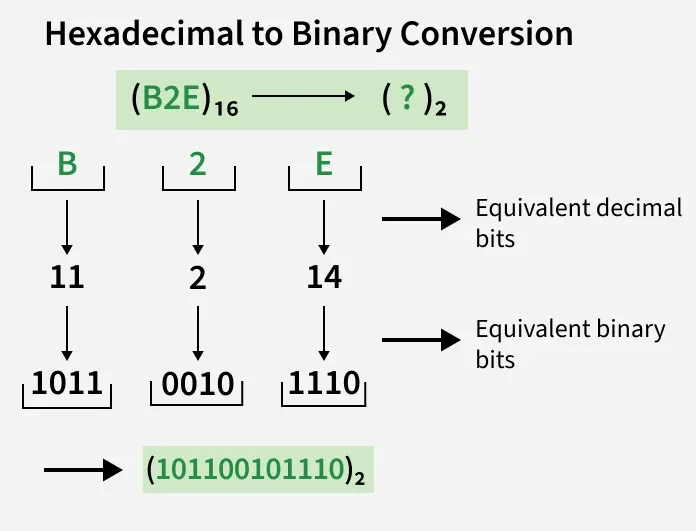
Each hexadecimal digit corresponds to a 4-bit binary sequence. Convert each digit individually and combine.
Example: (B2E)16 is to be converted to binary
Follow the steps given below:
- Step 1: Convert the Hex symbols into their equivalent decimal values.
- Step 2: Write each digit of the Hexadecimal number separately.
- Step 3: Convert each digit into an equivalent group of four binary digits.
- Step 4: Combine these groups to form the whole binary number.
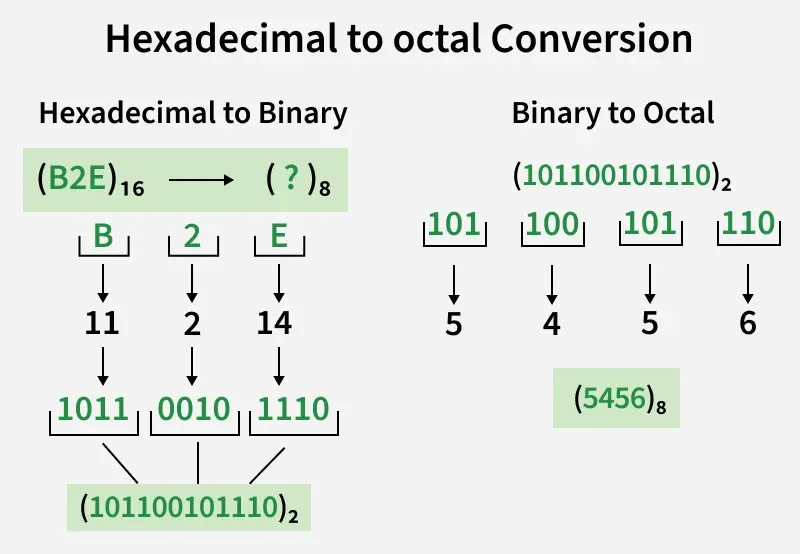
Convert hexadecimal to binary, group the binary digits into sets of three (right to left), and convert each group to its octal equivalent.
Example: (B2E)16 is to be converted to hex
Follow the steps given below:
- Step 1: We need to convert the Hexadecimal number to Binary first. For that, follow the steps given in the above conversion.
- Step 2: Now to convert the binary number to an Octal number, divide the binary digits into groups of three digits starting from right to left i.e. from LSB to MSB.
- Step 3: Add zeros before MSB to make it a proper group of three digits(if required)
- Step 4: Now convert these groups into their relevant decimal values.
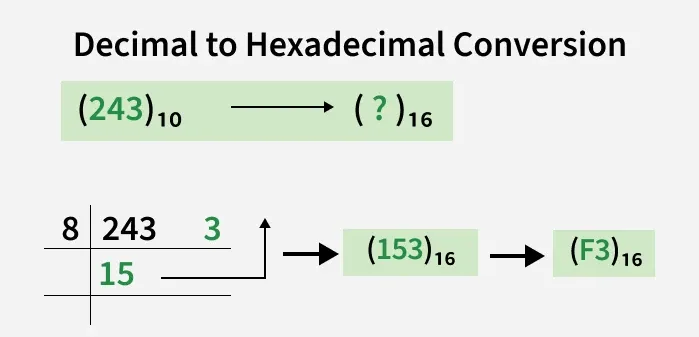
Divide the decimal number by 16 repeatedly, noting remainders, until the quotient is 0. Read remainders in reverse order, using A–F for 10–15.
Example 1: Convert Hexadecimal 1A5 to Decimal
Solution:
Multiply First Digit (1) by 16 squared (256)
1×162 = 256
Multiply Second Digit (A, which is 10 in decimal) by 16 to the power of 1 (16)
10×161 = 160
Multiply Third Digit (5) by 16 to the power of 0 (1)
5×160 = 5
Adding the results,
1A5 = 1×162 +A×161 + 5×160
⇒ 1A5 = 1×162 + 10×161 + 5×160
⇒ 1A5 = 256 + 160 + 5 = 421
Decimal Equivalent of Hexadecimal number 1A5 is 421
Example 2: Convert Decimal 315 to Hexadecimal.
Solution:
Divide Decimal Number by 16
315÷16 = 19 with Remainder 11
The remainder (11) is represented as B in hexadecimal
Repeat the division with the quotient (19)
19÷16 = 1 with Remainder of 3
The remainder (3) is represented as 3 in hexadecimal
Hexadecimal Equivalent of Decimal Number 315 is 13B
Example 3: Convert (1F7)16 to Octal.
Solution:
Step 1: Convert (1F7)16 to decimal using the powers of 16:
(1F7)16 = 1 × 162 + 15 × 161 + 7 × 160
⇒ (1F7)16 = 1 × 256 + 15 × 16 + 7 × 1
⇒ (1F7)16 = 256 + 240 + 7
⇒ (1F7)16 = (503)10
Step 2: Convert the decimal number (503)10 to octal by dividing it by 8 until the quotient is 0
503 ÷ 8 = 62 with a remainder of 7
62 ÷ 8 = 7 with a remainder of 6
7 ÷ 8 = 0 with a remainder of 7
Arrange the remainder from bottom to top
Therefore, (1F7)16 is equivalent to (767)8 in octal
Example 4: Convert (A7B)16 to decimal.
(A7B)16 = A × 162 + 7 × 161 + B × 160
⇒ (A7B)16 = 10 × 256 + 7 × 16 + 11 × 1 (convert symbols A and B to their decimal equivalents; A = 10, B = 11)
⇒ (A7B)16 = 2560 + 112+ 11
⇒ (A7B)16 = 2683
Therefore, the decimal equivalent of (A7B)16 is (2683)10.
Question 1: Convert the hexadecimal number 2A to binary.
Question 2: Convert the binary number 110110 to hexadecimal.
Question 3: Add the hexadecimal numbers 1F and A3. Provide the result in hexadecimal.
Question 4: Subtract the hexadecimal number B6 from D9. Provide the result in hexadecimal.
Question 5: Multiply the hexadecimal number 7E by 3. Provide the result in hexadecimal.
1. 101010
2. 36
3.C2
4.23
5.17A