|
VOOZH | about |
|
VOOZH | about |
Trigonometric Functions, often simply called trig functions, are mathematical functions that relate the angles of a right triangle to the ratios of the lengths of its sides. There are six basic trigonometric functions used in Trigonometry, which are:
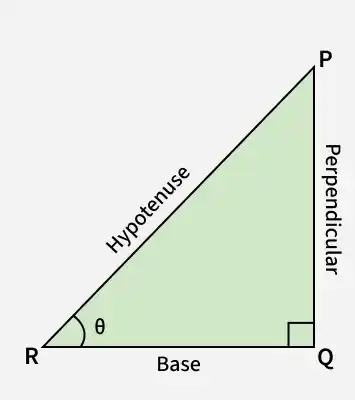
The image added below shows a right-angle triangle PQR.
Then the six basic trigonometric functions formulas for this right-angle triangle are,
Function | Sides | Description | Relation |
|---|---|---|---|
sin θ | PQ/PR | Perpendicular/Hypotenuse | sin θ = 1/cosec θ |
cos θ | QR/PR | Base/Hypotenuse | cos θ = 1/sec θ |
tan θ | PQ/QR | Perpendicular/Base | tan θ = 1/cot θ |
sec θ | PR/QR | Hypotenuse/Base | sec θ = 1/cos θ |
cosec θ | PR/PQ | Hypotenuse/Perpendicular | cosec θ = 1/sin θ |
cot θ | QR/PQ | Base/Perpendicular | cot θ = 1/tan θ |
Some of the common properties of trigonometric functions are discussed below:
Period refers to the length of one complete cycle of a trigonometric function, after which the function repeats.
Symmetry refers to the property that describes how the function behaves under reflection, translation, or rotation.
Learn in detail