|
VOOZH | about |
|
VOOZH | about |
Fractions are numerical expressions used to represent parts of a whole or ratios between quantities.
Example: If an apple is divided into 4 equal parts, and one part is taken out, thus the fraction representing the taken out part is 1/4 as one part is taken out of 4 equal parts.
If 3 parts are taken then the fraction representing the taken out part will be 3/4.
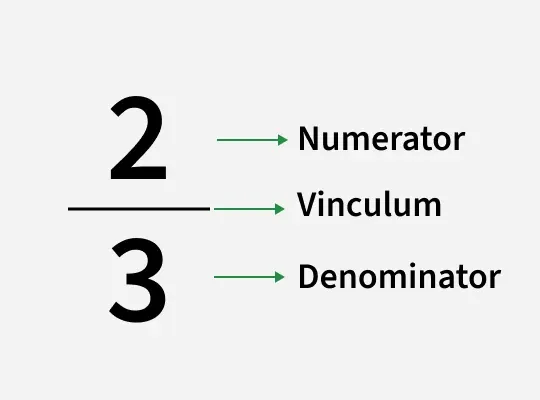
If we divide anything into some equal parts, then a fraction consists of two main parts and a fraction line:
👁 fractionThey are categorized based on their numerator and denominator, and they are:
1) Proper Fraction: Fractions in which the numerator value is less than the denominator value.
2) Improper Fractions: Fractions in which the numerator value is greater than the denominator value.
3) Mixed Fractions: A fraction that consists of a whole number with a proper fraction.
Fractions follow important mathematical properties similar to whole numbers and integers. These properties help us perform operations like addition and multiplication correctly.
1. Commutative Property (Addition and Multiplication)
The order of fractions does not change the result.
2. Associative Property (Addition and Multiplication)
The grouping of fractions does not change the result.
3. Identity Property
The identity element is a number that keeps the fraction unchanged.
4. Multiplicative Inverse
The reciprocal of a fraction, when multiplied by the original fraction, gives 1.
5. Distributive Property
Multiplying a fraction by a sum is the same as multiplying each fraction separately and then adding the results.
Practice the fractions with these useful worksheets on fractions.