|
VOOZH | about |
|
VOOZH | about |
Inverse trigonometric identities are mathematical expressions involving inverse trigonometric functions such as sin-1(x), cos-1(x), and tan-1(x), etc. These functions provide the angles (or arcs) corresponding to a given trigonometric ratio.
The inverse trigonometric identities help in simplifying complex expressions and solving equations involving trigonometric functions.
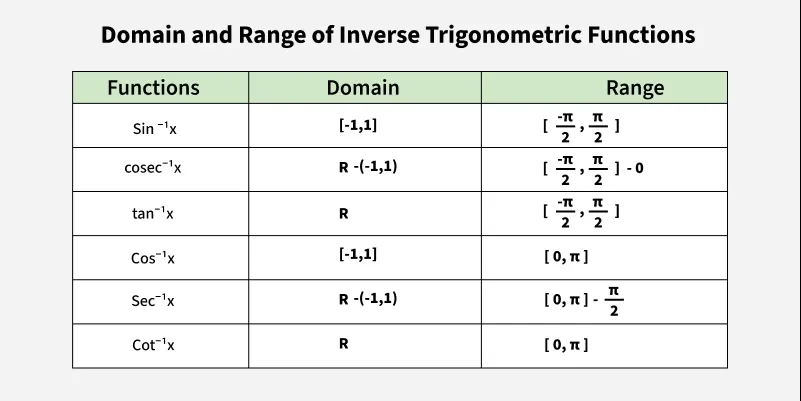
The following table shows the inverse-trigonometric functions with their domain and range.
The following are the properties of inverse trigonometric functions:
Property 1:
- sin-1 (1/x) = cosec-1 x, for x ≥ 1 or x ≤ -1
- cos-1 (1/x) = sec-1 x, for x ≥ 1 or x ≤ -1
- tan-1 (1/x) = cot-1 x, for x > 0
Property 2:
- sin-1 (-x) = -sin-1 x, for x ∈ [-1 , 1]
- tan-1 (-x) = -tan-1 x, for x ∈ R
- cosec-1 (-x) = -cosec-1 x, for |x| ≥ 1
Property 3
- cos-1 (-x) = π - cos-1 x, for x ∈ [-1 , 1]
- sec-1 (-x) = π - sec-1 x, for |x| ≥ 1
- cot-1 (-x) = π - cot-1 x, for x ∈ R
Property 4
- sin-1 x + cos-1 x = π/2, for x ∈ [-1,1]
- tan-1 x + cot-1 x = π/2, for x ∈ R
- cosec-1 x + sec-1 x = π/2 , for |x| ≥ 1
Property 5
- tan-1 x + tan-1 y = tan-1 ( x + y )/(1 - xy), for xy < 1
- tan-1 x - tan-1 y = tan-1 (x - y)/(1 + xy), for xy > -1
- tan-1 x + tan-1 y = π + tan-1 (x + y)/(1 - xy), for xy >1 ; x, y >0
Property 6
- 2tan-1 x = sin-1 (2x)/(1 + x2), for |x| ≤ 1
- 2tan-1 x = cos-1 (1 - x2)/(1 + x2), for x ≥ 0
- 2tan-1 x = tan-1 (2x)/(1 - x2), for -1 < x <1
The following are the identities of inverse trigonometric functions:
- sin-1 (sin x) = x provided -π/2 ≤ x ≤ π/2
- cos-1 (cos x) = x provided 0 ≤ x ≤ π
- tan-1 (tan x) = x provided -π/2 < x < π/2
- sin(sin-1 x) = x provided -1 ≤ x ≤ 1
- cos(cos-1 x) = x provided -1 ≤ x ≤ 1
- tan(tan-1 x) = x provided x ∈ R
- cosec(cosec-1 x) = x provided -1 ≤ x ≤ ∞ or -∞ < x ≤ 1
- sec(sec-1 x) = x provided 1 ≤ x ≤ ∞ or -∞ < x ≤ 1
- cot(cot-1 x) = x provided -∞ < x < ∞
- 2cos-1 x = cos-1 (2x2 - 1)
- 2sin-1x = sin-1 2x√(1 - x2)
- 3sin-1x = sin-1(3x - 4x3)
- 3cos-1 x = cos-1 (4x3 - 3x)
- 3tan-1x = tan-1((3x - x3/1 - 3x2))
- sin-1x + sin-1y = sin-1{ x√(1 - y2) + y√(1 - x2)}
- sin-1x - sin-1y = sin-1{ x√(1 - y2) - y√(1 - x2)}
- cos-1 x + cos-1 y = cos-1 [xy - √{(1 - x2)(1 - y2)}]
- cos-1 x - cos-1 y = cos-1 [xy + √{(1 - x2)(1 - y2)}
- tan-1 x + tan-1 y = tan-1(x + y/1 - xy)
- tan-1 x - tan-1 y = tan-1(x - y/1 + xy)
- tan-1 x + tan-1 y +tan-1 z = tan-1 (x + y + z - xyz)/(1 - xy - yz - zx)
Question 1: Prove sin-1 x = sec-1 1/√(1-x2)
Solution:
Let sin-1 x = y
⇒ sin y = x , (since sin y = perpendicular/hypotenuse ⇒ cos y = √(1- perpendicular2 )/hypotenuse )
⇒ cos y = √(1 - x2), here hypotenuse = 1
⇒ sec y = 1/cos y
⇒ sec y = 1/√(1 - x2)
⇒ y = sec-1 1/√(1 - x2)
⇒ sin-1 x = sec-1 1/√(1 - x2)Hence, proved.
Question 2: Prove tan-1 x = cosec-1 √(1 + x2)/x
Solution:
Let tan-1 x = y
⇒ tan y = x , perpendicular = x and base = 1
⇒ sin y = x/√(x2 + 1) , (since hypotenuse = √(perpendicular2 + base2 ) )
⇒ cosec y = 1/sin y
⇒ cosec y = √(x2 + 1)/x
⇒ y = cosec-1 √(x2 + 1)/x
⇒ tan-1 x = cosec-1 √(x2 + 1)/xHence, proved.
Question 3: Evaluate tan(cos-1 x)
Solution:
Let cos-1 x = y
⇒ cos y = x , base = x and hypotenuse = 1 therefore sin y = √(1 - x2)/1
⇒ tan y = sin y/ cos y
⇒ tan y = √(1 - x2)/x
⇒ y = tan-1 √(1 - x2)/x
⇒ cos-1 x = tan-1 √(1 - x2)/xTherefore, tan(cos-1 x) = tan(tan-1 √(1 - x2)/x ) = √(1 - x2)/x.
Question 4: tan-1 √(sin x) + cot-1 √(sin x) = y. Find cos y.
Solution:
We know that tan-1 x + cot-1 x = /2 therefore comparing this identity with the equation given in the question we get y = π/2
Thus, cos y = cos π/2 = 0.
Question 5: tan-1 (1 - x)/(1 + x) = (1/2)tan-1 x, x > 0. Solve for x.
Solution:
tan-1 (1 - x)/(1 + x) = (1/2)tan-1 x
⇒ 2tan-1 (1 - x)/(1 + x) = tan-1 x …(1)We know that, 2tan-1 x = tan-1 2x/(1 - x2).
Therefore, LHS of equation (1) can be written as
tan-1 [ { 2(1 - x)/(1 + x)}/{ 1 - [(1 - x)(1 + x)]2}]
= tan-1 [ {2(1 - x)(1 + x)} / { (1 + x)2 - (1 - x)2 }]
= tan-1 [ 2(1 - x2)/(4x)]
= tan-1 (1 - x2)/(2x)Since, LHS = RHS therefore
tan-1 (1 - x2)/(2x) = tan-1 x
⇒ (1 - x2)/2x = x
⇒ 1 - x2 = 2x2
⇒ 3x2 = 1
⇒ x = ± 1/√3Since, x must be greater than 0 therefore x = 1/√3 is the acceptable answer.
Question 6: Prove tan-1 √x = (1/2)cos-1 (1 - x)/(1 + x)
Solution:
Let tan-1 √x = y
⇒ tan y = √x
⇒ tan2 y = xTherefore,
RHS = (1/2)cos-1 ( 1- tan2 y)/(1 + tan2 y)
= (1/2)cos-1 (cos2 y - sin2 y)/(cos2 y + sin2 y)
= (1/2)cos-1 (cos2 y - sin2 y)
= (1/2)cos-1 (cos 2y)
= (1/2)(2y)
= y= tan-1 √x
= LHSHence, proved.
Question 7: tan-1 (2x)/(1 - x2) + cot-1 (1 - x2)/(2x) = π/2, -1 < x < 1. Solve for x.
Solutions:
tan-1 (2x)/(1 - x2) + cot-1 (1 - x2)/(2x) = π/2
⇒ tan-1 (2x)/(1 - x2) + tan-1 (2x)/(1 - x2) = π/2
⇒ 2tan-1 (2x)/(1 - x2) = ∏/2
⇒ tan-1 (2x)/(1 - x2) = ∏/4
⇒ (2x)/(1 - x2) = tan ∏/4
⇒ (2x)/(1 - x2) = 1
⇒ 2x = 1 - x2⇒ x2 + 2x -1 = 0
⇒ x = [-2 ± √(22 - 4(1)(-1))] / 2
⇒ x = [-2 ± √8] / 2
⇒ x = -1 ± √2
⇒ x = -1 + √2 or x = -1 - √2But according to the question x ∈ (-1, 1) therefore for the given equation the solution set is x ∈ ∅.
Question 8: tan-1 1/(1 + 1.2) + tan-1 1/(1 + 2.3) + … +tan-1 1/(1 + n(n + 1)) = tan-1 x. Solve for x.
Solution:
tan-1 1/(1 + 1.2) + tan-1 1/(1 + 2.3) + … + tan-1 1/(1 + n(n + 1)) = tan-1 x
⇒ tan-1 (2 - 1)/(1 + 1.2) + tan-1 (3 - 2)/(1 + 2.3) + … + tan-1 (n + 1 - n)/(1 + n(n + 1)) = tan-1 x
⇒ (tan-1 2 - tan-1 1) + (tan-1 3 - tan-1 2) + … + (tan-1 (n + 1) - tan-1 n) = tan-1 x
⇒ tan-1 (n + 1) - tan-1 1 = tan-1 x
⇒ tan-1 n/(1 + (n + 1).1) = tan-1 x
⇒ tan-1 n/(n + 2) = tan-1 x
⇒ x = n/(n + 2)
Question 9: If 2tan-1 (sin x) = tan-1 (2sec x) then solve for x.
Solution:
2tan-1 (sin x) = tan-1 (2sec x)
⇒ tan-1 (2sin x)/(1 - sin2 x) = tan-1 (2/cos x)
⇒ (2sin x)/(1 - sin2 x) = 2/cos x
⇒ sin x/cos2 x = 1/cos x
⇒ sin x cos x = cos2 x
⇒ sin x cos x - cos2 x = 0
⇒ cos x(sin x - cos x) = 0
⇒ cos x = 0 or sin x - cos x = 0⇒ cos x = cos π/2 or tan x = tan π/4
⇒ x = π/2 or x = π/4But at x = π/2 the given equation does not exist hence x = π/4 is the only solution.
Question 10: Prove that cot-1 [ {√(1 + sin x) + √(1 - sin x)}/{√(1 + sin x) - √(1 - sin x)}] = x/2, x ∈ (0, π/4)
Solution:
Let x = 2y therefore
LHS = cot-1 [{√(1+sin 2y) + √(1-sin 2y)}/{√(1+sin 2y) - √(1-sin 2y)}]
= cot-1 [{√(cos2 y + sin2 y + 2sin y cos y) + √(cos2 y + sin2 y - 2sin y cos y)}/{√(cos2 y + sin2 y + 2sin y cos y) - √(cos2 y + sin2 y - 2sin y cos y)} ]
= cot-1 [{√(cos y + sin y)2 + √(cos y - sin y)2} / {√(cos y + sin y)2 - √(cos y - sin y)2}] = cot-1 [( cos y + sin y + cos y - sin y )/(cos y + sin y - cos y + sin y)]
= cot-1 (2cos y)/(2sin y)= cot-1 (cot y)
= y
= x/2.
Question 1: Solve for x in the equation sin-1(x) + cos-1(x) = π/2.
Question 2: Prove that tan-1(1) + tan-1(2) + tan-1(3) = π.
Question 3: Evaluate cos(sin-1(0.5))
Question 4: If tan-1(x) + tan-1(2x) = π/4, then find x.
Answer:-
- x ∈ [-1, 1]
- π
- √3/2.
- (-3±√17)/4