|
VOOZH | about |
|
VOOZH | about |
Differentiability is a property of a function that tells us whether it has a well-defined tangent line (or slope) at a given point. A function f(x) is said to be differentiable at a point x = a if the limit
exists and is finite.
That limit, when it exists, is the derivative of f at a, denoted f′(a).
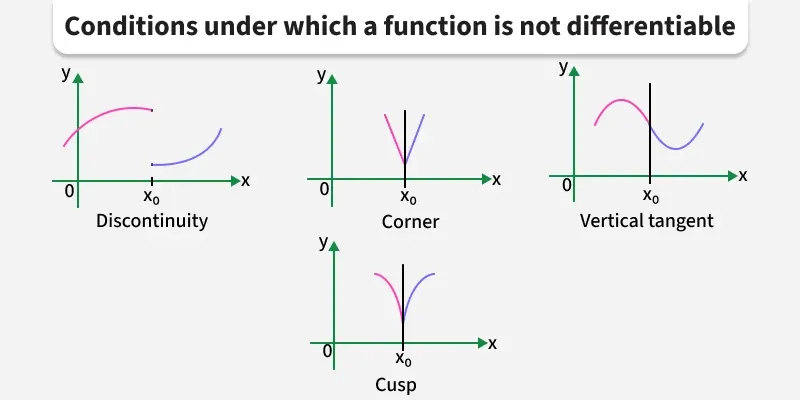
For a function to be differentiable, the following conditions must be satisfied:
Note: The relationship between continuity and differentiability is that all differentiable functions happen to be continuous but not all continuous functions can be said to be differentiable.
Step 1: Check Continuity at x = a
Differentiability implies continuity. If f is not continuous at aa it is not differentiable.
limx→a f(x) = f(a)
If discontinuos, it is not differentiable
If continuos, proceed to Step 2.
Step 2:Compute the Derivative Using the Limit Definition
For Piecewise functions or points where behaviour changes, compute left-hand derivative(LHD) and right-hand derivative(RHD).
Differentiability Condition: LHD = RHD
If LHD and RHD are equal and finite, f is differentiable at a.
Theorem: "Differentiability implies continuity " - If a function f is differentiable at a point x = a, then f is continuous at x = a.
Proof:
Assume f is differentiable at x = a. Then, the derivative exists:
Consider :
Multiply and divide by h:
Because f is differentiable at a, and
So:
Hence f is continuous at x = a. Converse is not true (e.g., |x| is continuous but not differentiable at 0).
Let us consider two important piecewise-defined functions:
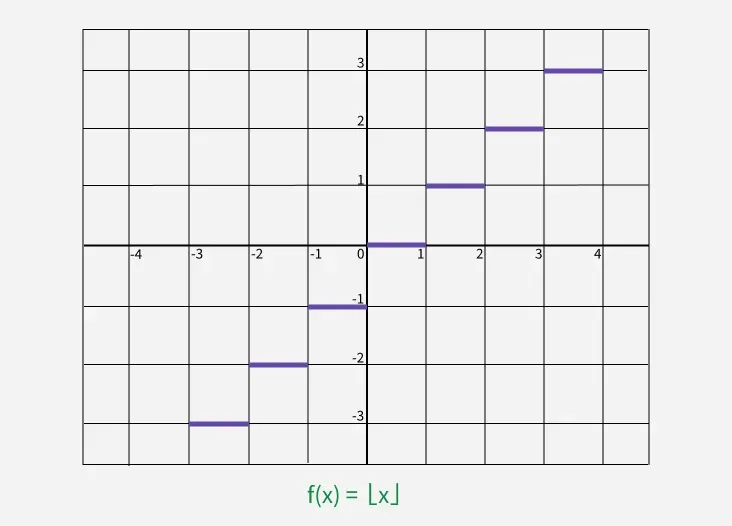
The floor function returns the greatest integer less than or equal to x.
Graph and Behavior:
Domain and Range
Differentiability Analysis:
At Integer Points (e.g., x = 1):
At Non-Integer Points (e.g., x = 2.5):
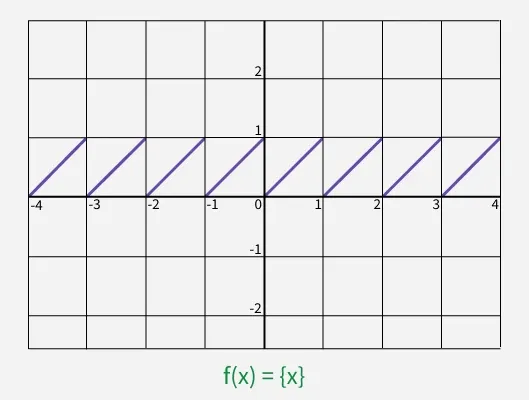
The fractional part function is defined as {x} = x − ⌊x⌋.
Graph and Behavior
Domain and Range
Differentiability Analysis
At Integer Points (e.g., x = 1):
At Non-Integer Points (e.g., x = 1.5):
This table explains the major trigonometric functions and their differentiability.
Function | Domain | Differentiability | Derivative |
|---|---|---|---|
f(x) = sin x | R | Differentiable everywhere on R. | |
f(x) = cos x | R | Differentiable everywhere on R. | |
f(x) = tan x | {x ∈ R ∣ x ≠π/2 + kπ, k ∈ Z} | Differentiable at every point in its domain. | |
f(x) = sec x | {x ∈ R ∣ x ≠π/2 + kπ, k ∈ Z} | Differentiable wherever they are defined (i.e., where denominators are non-zero). | |
f(x) = cosec x | {x ∈ R ∣ x ≠kπ, k ∈ Z} | Differentiable wherever they are defined (i.e., where denominators are non-zero). | |
f(x) = cot x | {x ∈ R ∣ x ≠kπ, k ∈ Z} | Differentiable wherever they are defined (i.e., where denominators are non-zero). |
Example 1: Prove that the greatest integer function defined by f(x) = [x] , 0 < x < 3 is not differentiable at x = 1 and x = 2.
Solution:
As question given f(x) = [x] where x is greater than 0 and also less than 3. So we have to check the function is differentiable at point x =1 and at x = 2 or not. To check the differentiability of function, as we discussed above in Differentiation that LHD at(x = a) = RHD at (x = a) which means,
Lf' at (x = a) = Rf' at (x = a) if they are not equal after solving and putting the value of a in place of x then our function should not differentiable and if they both comes equal then we can say that the function is differentiable at x = a, we have to solve for two points x = 1 and x = 2.
Now, let's solve for x = 1
f(x) = [x]Put x = 1 + h
Rf' = limh -> 0 f(1 + h) - f(1)
= limh -> 0 [1 + h] - [1]Since [h + 1] = 1
= limh -> 0 (1 - 1) / h = 0Lf'(1) = limh -> 0 [f(1 - h) - f(1)] / -h
= limh -> 0 ( [1 - h] - [1] ) / -hSince [1 - h] = 0
= limh -> 0 (0 - 1) / -h
= -1 / -0
= ∞From the above solution it is seen that Rf' ≠ Lf', so function f(x) = [x] is not differentiable at x = 1. Now, let's check for x = 2. As we solved for x = 1 in the same we are going to solve for x = 2. Condition should be the same we have to check that, Lf' at (x = 2) = Rf' at (x = 2) or not if they are equal then our function is differentiable at x = 2 and if they are not equal our function is not differentiable at x = 2. So, let's solve.
f(x) = [x]
Differentiability at x=2
Put x = 2 + h
Rf'(1) = limh -> 0 f(2 + h) - f(2)
= limh -> 0 ([2 + h] - [2]) / hSince 2 + h = 2
= limh -> 0 (2 - 2) / h
= limh -> 0 0 / h
=0Lf'(1) = limh -> 0 (f(2 - h) - f(2)) / -h
= limh -> 0 ([2 - h] - [2]) / -h
= limh -> 0 (1 - 2) / -hSince [2 - h] = 1
= -1 / -0
= ∞From the above solution it is seen that Rf'(2) ≠ Lf'(2), so f(x) = [x] is not differentiable at x = [2]
Example 2:
Show that the above function is not derivable at x = 0.
Solution:
As we know to check the differentiability we have to find out Lf' and Rf' then after comparing them we get to know that the function is differentiable at the given point or not. So let's first find the Rf'(0).
Rf'(0) = limh -> 0 f(0 + h) - f(0)
= limh -> 0 (f(h) - f(0)) / h
= limh -> 0 h . [{(e(1 / h) - 1) / (e(1 / h) + 1) } - 0]/h
= limh -> 0 (e(1 / h) - 1) / (e(1 / h) + 1)Multiply by e(-1 / h)
= limh -> 0 {1 - e(-1 / h) / 1 + e(-1 / h)}
= (1 - 0) / (1 + 0)
= 1After solving we had find the value of Rf'(0) is 1. Now after this let's find out the Lf'(0) and then we will check that the function is differentiable or not.
Lf'(0) = limh -> 0 { f(0 - h) - f(0) } / -h
= limh -> 0 -h . [{e(-1 / h) - 1 / e(-1 / h) + 1} - 0] / -h
= limh -> 0 { (e(-1 / h) - 1) / (e(-1 / h) + 1) }
= limh -> 0 { (1 - e(-∞))/ (1+e(-∞))}
= (0 - 1) / (0 + 1)
= -1As we saw after solving Lf'(0) the value we get -1. Now checking if the function is differentiable or not, Rf'(0) ≠ Lf'(0) (-1≠1). Since Rf'(0) ≠ Lf'(0), so f(x) is not differentiable at x = 0.
Example 3: A function is f(x) defined by
If function f(x) differentiable at x = 2?
Solution:
So, for finding Lf'(2) we take the function f(x) = 1 = x, in the same way for finding Rf'(2) we take the function f(x) = (5 - x). Let's find out Lf'(2) and Rf'(2)
Lf'(2) = limh -> 0 {f(2 - h) - f(2)} / -h
= limh -> 0 [[(2 - h) + 1] - [5 - 2]] / -h
= limh -> 0 (3 - h - 3) / -h
= limh -> 0 -h / -h
= 1Rf'(2) = limh -> 0 {f(2 + h) - f(2)} / h
= limh -> 0 [[5 - (2 + h)] - 3] / h = limh-> 0 [5-2-h - 3] / h
=limh -> 0 -h / h
= -1In the first line Lf'(2) after putting in the formula, for f(2) we are putting second function (5 - x). After solving the Lf'(2) we get the value 1.
For calculating Rf'(2) we are using the second function 5-x and putting in the formula of Rf', on solving the Rf'(2) we get the value -1.Since, Rf'(2) ≠ Lf'(2) so we can say the function f(x) is not differentiable at x = 2.