|
VOOZH | about |
|
VOOZH | about |
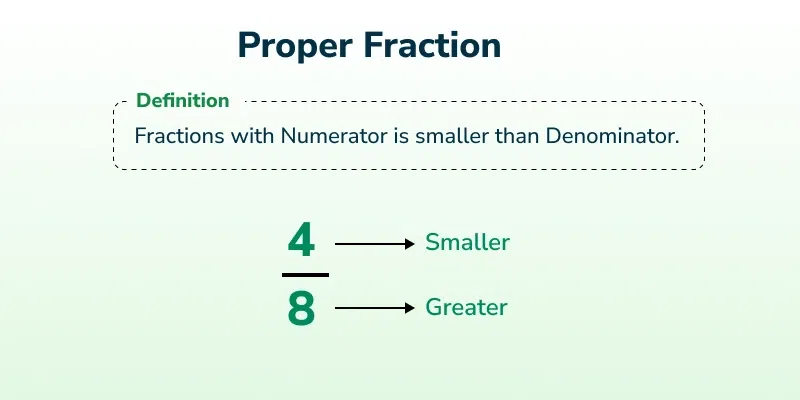
A proper fraction is a type of fraction where the numerator is less than the denominator. This means the value of a proper fraction is always less than 1.
Examples of Proper Fractions are:
• 1/2 (one-half)
• 3/4 (three-quarters)
• 2/5 (two-fifths)
Fractions which have values either equal or greater than 1 will always be Improper Fraction.
For Example:
To identify whether any fraction is proper or not, first identify its numerator and denominator. Then, if
Let's consider an example for better understanding.
Proper fraction can be added, subtracted, multiplied or divided with each other similar to any other fractions. For any two fractions a/b and c/d, formulas of each operations are:
| Operation | Formula | Example |
|---|---|---|
| Addition | ||
| Subtraction | ||
| Multiplication | ||
| Division |
Some of the key difference between proper and improper fractions are:
| Feature | Proper Fraction | Improper Fraction |
|---|---|---|
| Definition | Numerator is less than the denominator. | Numerator is greater than or equal to the denominator. |
| Value | Always less than 1. | Equal to or greater than 1. |
| Representation | Can be a part of a whole. | Can represent a whole number or more. |
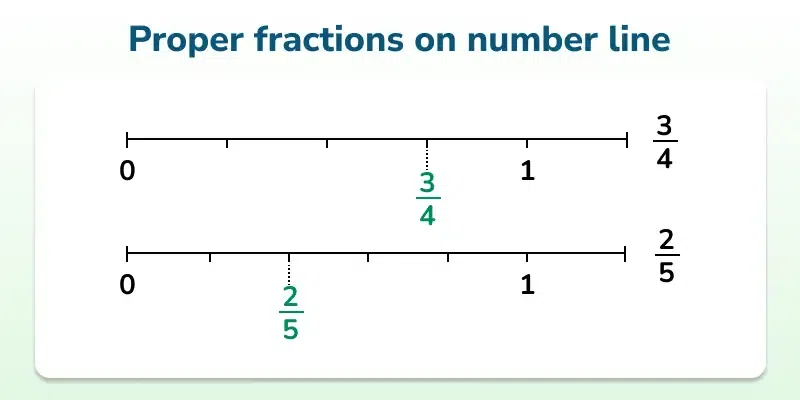
Since the value of a proper fraction is less than 1, it is always placed between 0 and 1 on a number line. The whole part between 0 and 1 is divided into equal parts based on the denominator, and the numerator shows the fraction’s position. For example, to represent 3/4, divide the space between 0 and 1 into 4 parts, and the third part marks 3/4, in 2/5 the space between 0 and 1 is divided into 5 parts and the second part represents 2/5.
Read More: