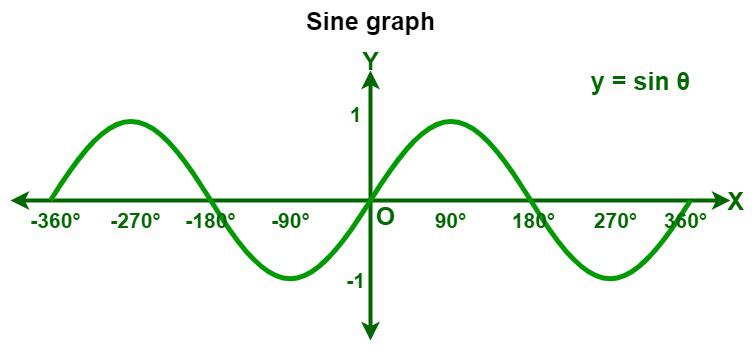
Trigonometric graphs show the repeating behavior of functions like sine, cosine, and tangent. Each graph has important features such as period, amplitude, symmetry, and intercepts, which help describe its shape and behavior.
The period of the cosine function is 2π and its zeros fall at odd multiples of π/2. It is the sine graph shifted π/2 units to the left, and is symmetric about the Y-axis, making it an even function.
The tangent function is undefined at odd multiples of π/2 where cos θ = 0, creating vertical asymptotes there. Its period is π and its range is all real numbers since it has no maximum or minimum.
The cotangent function is the reciprocal of tangent, undefined at every integer multiple of π where sin θ = 0. Its period is π and it has no Y-intercept since x = 0 is one of its undefined points.
The cosecant function is the reciprocal of sine, undefined at every integer multiple of π. Its period is 2π and it has no intercepts of any kind. Its range excludes (−1, 1), taking only values of magnitude 1 or greater.
The secant function is the reciprocal of cosine, undefined at odd multiples of π/2. Its period is 2π and its range also excludes (−1, 1). It inherits cosine's symmetry about the Y-axis, making it an even function.
θ
0°
90°
180°
270°
y = sec θ
1
undefined
−1
undefined
Domain
R - (2n + 1)π/2
Range
(-∞, -1] U [+1, +∞)
Y−intercept
y = 1
Line of symmetry
Y-axis
Vertical asymptotes
x = (2n + 1)π/2
Important Features
For every trigonometric graph, there are important features:
Amplitude: Amplitude is half of the distance between the maximum value and the minimum value, or the height of the curve from the center line.
Vertical Shift: The displacement of the graph up or down (parallel to the y-axis).
Period: The period is the distance between the repetitions of any function.
Phase: The position of the waveform at a fraction of a period is referred to as its phase, and it is expressed in angles or radians.
Phase Shift: The displacement of the graph parallel to the x-axis (horizontal shift).
We know that the amplitude of the graph of a tangent function is undefined as the curve does not have a maximum or a minimum value and tends to infinity.
Now, compare the given equation with the general form y = a sin (bx + c) + d,
a = 2, which means the amplitude is 2. (So, the distance between the maximum and minimum value is 2) b = 1. Period = 2π/|1| = 2π/|1| = 2π c = 0, so there is no phase shift. d = 3, which means the graph moved upwards by 3 units.