|
VOOZH | about |
|
VOOZH | about |
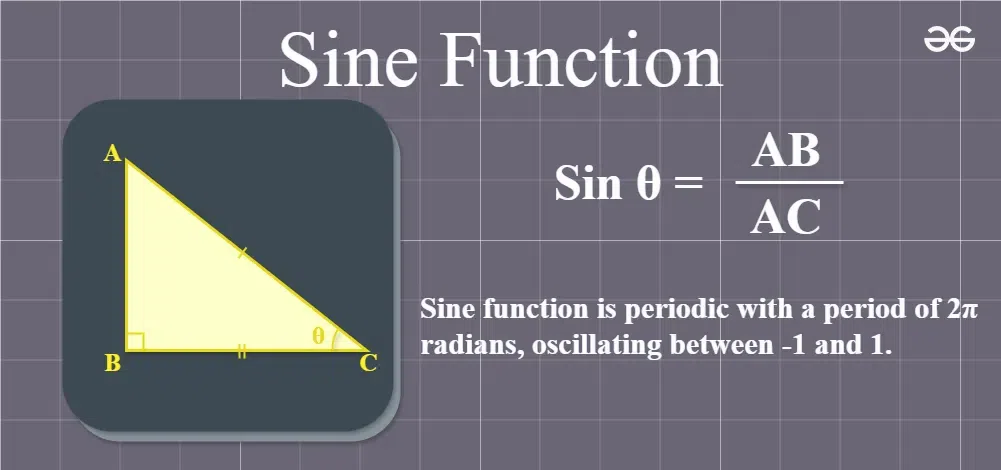
Sine Function in trigonometry is one of the fundamental trigonometric ratios, which can be defined as the ratio of the perpendicular to the hypotenuse in any right-angle triangle.
Mathematically, it is expressed as:
The sine function is one of the primary trigonometric functions, including tan x, cos x, sec x, cot x, and cosec x.
In this article, we will discuss the Sine Function in Trigonometry, its definition, formula, and values of the Sine Function for different values of angles, as well as its key properties like domain and range, period, and the graph of the Sine Function.
Table of Content
If we suppose a right-angled triangle △ABC, then for an angle θ we define sin(θ) as:
The sine function, sin(x), has several important mathematical properties and graphical features that make it unique and widely used in trigonometry, some of which we will discuss below:
The domain of a function includes all possible input values (x-values) for which the function is defined, while the range consists of all possible output values (y-values) the function can produce.
For the sine function, the domain is all real numbers, since (sin x) is defined for every real value of x:
- Domain of sin function = All real numbers (−∞, ∞)
- Range of sin function = [-1, 1]
| Degree Range | Quadrant | Sine Function Sign | Sine Value Range |
|---|---|---|---|
| 0 to 90 Degrees | 1st Quadrant | + (Positive) | 0 < sin(x) < 1 |
| 90 to 180 Degrees | 2nd Quadrant | + (Positive) | 0 < sin(x) < 1 |
| 180 to 270 Degrees | 3rd Quadrant | – (Negative) | -1 < sin(x) < 0 |
| 270 to 360 Degrees | 4th Quadrant | – (Negative) | -1 < sin(x) < 0 |
Since the Sine function is a periodic function, we can define the period after which the values of the Sine function begin to repeat. The period of the Sine function is 2π and can be written as:
sin (2nπ + x) = sin x (for all n ∈ integer)
- Period of sin function = 2π
For instance, sin(2π) = 0. If you add 2π to the x, you get sin(2π + 2π), which is sin(4π). Just like sin(2π), sin(4π) = 0. Every time you add or subtract 2π from our x-x-value, the solution will be the same.
A function f(x) is called odd if:
f(-x) = -f(x)
for all x in the domain of f.For the sine function:
sin(-x) = -sin(x)
This property holds for all real values of x.
The reciprocal of the sine function is called cosecant(cosec). We can write it as:
1/sin(x) = cosec(x)
OR
cosec(x) = Hypotenuse/Opposite
The product of the reciprocal of sine and the sine function is always equal to 1, which means:
cosec(x) × sin(x) = 1
From the formula of cosec(x), we can note that cosec(x) will be defined for all values of x except where sin(x) is 0, so we can define the domain and range of the reciprocal of sin(x) as:
Read More about Reciprocal Identities.
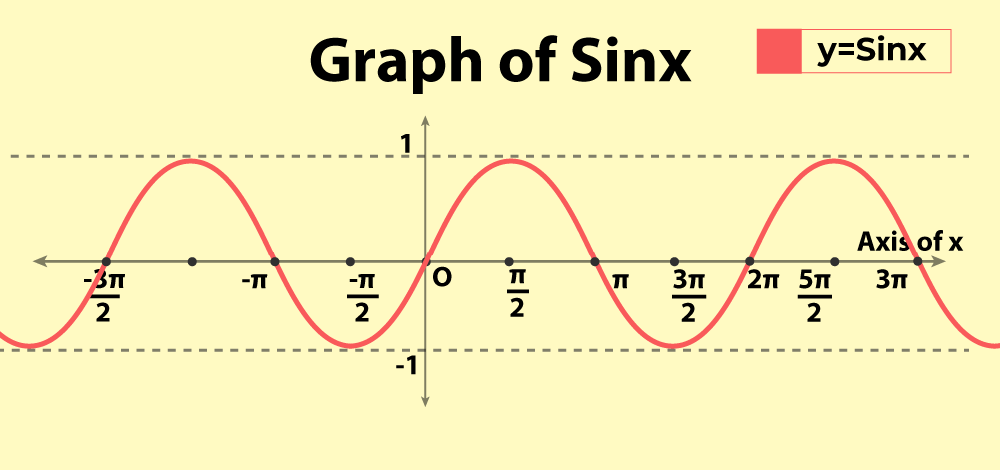
The graph of the sine function is a smooth, wave-like curve that oscillates between -1 and 1, repeating every 2π radians.
The graphical representation of the Sine Function:
We can see that Sine is a periodic function that repeats after 2π. The function starts from 0, attains a maximum value of +1 at π/2, and reaches a value of 0 at π. It further attains a minima of -1 at 3π/2 until it reaches the value 0 at 2π and starts repeating the cycle again. The graph represents an odd function. This means sin(-x)=-sin(x).
The periodicity of the graph is 2π.
Derivative of Sine Function: The derivative of the sine function, denoted as sin (x), concerning x is the cosine function, denoted as cos(x). In mathematical notation, this relationship is expressed as:
d/dx(sin (x)) = cos (x)
So, if you have a function y = sin (x), then the derivative dy/dx is equal to cos (x). This is a fundamental trigonometric identity in Calculus.
Integral of Sine Function: The integral of the sine function, denoted as sin (x), with respect to x is the negative cosine function, denoted as - cos (x), plus a constant of integration. In mathematical notation, this relationship is expressed as:
∫ sin (x) dx = - cos (x) + C
Here, C is the constant of integration, and it represents an arbitrary constant that can take any real value. When you differentiate - cos (x) + C concerning x, you get sin (x), verifying the relationship.
The value associated with each value of θ is given in the table:
| Angle(θ in Degrees) | Angle(θ in Radians) | Sin(θ) |
|---|---|---|
| 0° | 0 | 0 |
| 30° | π/6 | 1/2 |
| 45° | π/4 | 1/√2 |
| 60° | π/3 | √3/2 |
| 90° | π/2 | 1 |
| 120° | 2π/3 | √3/2 |
| 135° | 3π/4 | 1/2 |
| 180° | π | 0 |
| 270° | 3π/2 | -1 |
| 360° | 2π | 0 |
Read More about Trigonometric Table.
Some other common values of sine functions are:
| Sine 1 Degree is 0.84 | Sine 2 Degree is 0.91 |
| Sine 5 Degree is -0.96 | Sine 10 Degree is -0.54 |
| Sine 20 Degree is 0.91 | Sine 30 Degree is -0.99 |
| Sine 40 Degree is 0.75 | Sine 50 Degree is -0.26 |
| Sine 70 Degree is 0.77 | Sine 80 Degree is -0.99 |
| Sine 100 Degree is -0.50 | Sine 105 Degree is -0.97 |
| Sine 210 Degree is 0.47 | Sine 240 Degree is 0.95 |
| Sine 330 Degree is -0.13 | Sine 350 Degree is 0.95 |
Various properties of sine function are:
The inverse of a trigonometric function gives an inverse trigonometric function. So inverse of sine function is called arcsin.
We can represent it mathematically as "sin-1 (x)" or "arcsin x".
We call f-1 an inverse function of f if f(x) = y ⇒ x = f-1(y)
So sin x = y ⇒ x = sin-1(y).
also sin-1(sin(y)) = y.
We know that the inverse of a function exists if and only if it is bijective and the domain and range of a function are interchanged to be the range and domain of its inverse function, respectively. Hence,
The table for values of the inverse sine function is given below:
| x | y = sin-1(x) |
|---|---|
| -1 | -π/2 |
| -0.5 | -π/6 |
| 0 | 0 |
| 0.5 | π/6 |
| 1 | π/2 |
Here is a list of Sine function identities that can be used to ease the calculation:
Read More about Trigonometric Identities.
We have a very important law in mathematics that is used widely in trigonometry. This law is used to calculate the ratio of the length of a side and the sine of the angle opposite to that side in a triangle. It can be written as:
a/Sin(A)= b/Sin(B) = c/Sin(C)
This law can be used to calculate the length of a missing side or an angle. It is also called as Sine Rule, Sine Law, or Sine Formula.
We want to know how does sine and cosine function vary at different values of input angle, so here we compare the value of sine and cosine function for most values of angle.
| Angle(Degree) | Angle(Radian) | Sin(θ) | Cos(θ) |
|---|---|---|---|
| 0° | 0 | 0 | 1 |
| 30° | π/6 | 1/2 | √3/2 |
| 45° | π/4 | 1/√2 | 1/√2 |
| 60° | π/3 | √3/2 | 1/2 |
| 90° | π/2 | 1 | 0 |
| 120° | 2π/3 | √3/2 | -1/2 |
| 150° | 5π/6 | 1/2 | -√3/2 |
| 180° | π | 0 | -1 |
| 270° | 3π/2 | -1 | 0 |
| 360° | 2π | 0 | 1 |
Question 1: Find the value of sin (30°).
Solution:
sin(30°) = sin(π/6 radians)
sin(π/6) is a commonly known value, which is equal to 1/2.So, sin(30°) = 1/2.
Question 2: Find the value of sin(π/3).
Solution:
sin(π/3) is also a commonly known value, which is equal to √3/2.
Question 3: If sin(x) = 0.8, find the value of x in degrees.
Solution:
To find the value of x, we can take the inverse sine (arcsin) of 0.8:
x = arcsin(0.8)Using a calculator or table of trigonometric values, you can find that arcsin(0.8) is approximately 53.13°.
Question 4: If sin(2θ) = 0.6 and θ is in the first quadrant, find the value of θ in radians.
Solution:
To find the value of θ, we need to first find the value of 2θ. We can use the inverse sine function:
2θ = arcsin(0.6)
Now, find θ by dividing both sides by 2:
θ = (1/2) × arcsin(0.6)Using a calculator, you can determine that arcsin(0.6) is approximately 36.87 degrees. So,
θ ≈ (1/2) × 36.87 ≈ 18.44°.
Question 5: Calculate the value of sin(75°) without a calculator.
Solution:
We can use the identity sin (x+y) = sin x cos y + sin y cos x
Where x=30° and y=45°
On putting values, we getsin (75°) = 0.9659
Question 6: If sin(α) = 0.5 and cos(β) = 0.8, find sin(α + β).
Solution:
To find sin(α + β), you can use the sum of angles formula for sine:
sin(α + β) = sin(α) × cos(β) + cos(α) × sin(β)Using the given values:
⇒ sin(α + β) = 0.5 × 0.8 + √(1 - 0.52) × √(1 - 0.82)
⇒ sin(α + β) = 0.4 + √(1 - 0.25) × √(1 - 0.64)
⇒ sin(α + β) = 0.4 + √(0.75) × √(0.36)
⇒ sin(α + β) = 0.4 + 0.866 × 0.6
⇒ sin(α + β) ≈ 0.4 + 0.5196
⇒ sin(α + β) ≈ 0.9196So, sin(α + β) is approximately 0.9196.
Question 7: An electrician is climbing a 40 m long rope, which is tightly stretched and tied from the top of a vertical pole to the ground. Find the height of the pole if the angle made by the rope with the ground level is 60°.
Solution:
We notice that the figure will be of a right-angled triangle with rope as hypotenuse , vertical pole as perpendicular .
So sin (60°) = Perpendicular/HypotenuseThus, Height of Pole= 0.87 × 40 = 34.8 m [sin (60°) = 0.87]
Question 1: In △ABC, right-angled at B, if sin(A)=5/13. If the hypotenuse of the triangle is 13 in, then what is the length of the base of the triangle?
Question 2: Calculate the value of sin(135°) using trigonometric identities.
Question 3: Find all values in the range [π,5π] where sin(x)=1/2.
Question 4: A boat is attached to an anchor, which is 50m long and creates a line that is the hypotenuse of a right triangle. It makes an angle between the hypotenuse and the ocean floor that is 25°. So, what will be the depth of the anchor?
Question 5: Find two values x, y in the range [0,π] each such that sin of x+y is 0.96592582628.
The sine function (simply defined as the ratio of the perpendicular to the hypotenuse of a right triangle) is a fundamental element of trigonometry with applications spanning geometry, calculus, and various scientific fields. In modern-day, trigonometry and the sine function is used in fields like physics, engineering, computer graphics, and astronomy, and even in everyday applications like GPS navigation and architectural design, so is the Sine Function. The sine function is also important for understanding waveforms, oscillations.