|
VOOZH | about |
|
VOOZH | about |
Given a decimal number as input, we need to write a program to convert the given decimal number into an equivalent octal number. i.e convert the number with base value 10 to base value 8. The base value of a number system determines the number of digits used to represent a numeric value. For example, the binary number system uses two digits 0 and 1, the octal number system uses 8 digits from 0-7 and the decimal number system uses 10 digits 0-9 to represent any numeric value.
Examples:
Input : 16
Output: 20

Input : 10
Output: 12

Input : 33
Output: 41
For Example:
If the given decimal number is 16.
Step 1: Remainder when 16 is divided by 8 is 0. Therefore, arr[0] = 0.
Step 2: Divide 16 by 8. New number is 16/8 = 2.
Step 3: Remainder, when 2 is divided by 8, is 2. Therefore, arr[1] = 2.
Step 4: Divide 2 by 8. New number is 2/8 = 0.
Step 5: Since number becomes = 0.
Stop repeating steps and print the array in reverse order. Therefore, the equivalent octal number is 20.
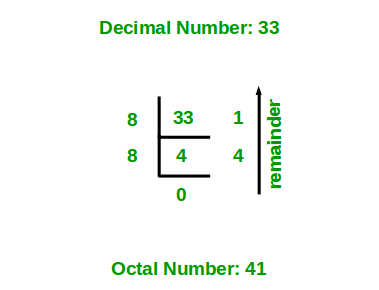
The below diagram shows an example of converting the decimal number 33 to an equivalent octal number.
Below is the implementation of the above idea.
41
Auxiliary Space: O(L) where L is the number of digits in octal number.
This problem can also be solved without using an array using the following algorithm:
Below is the implementation of the above idea:
41
Time Complexity: O(log N)
Auxiliary Space: O(1)
Using a predefined function
41
Time complexity: O(1).
Space complexity: O(1).