|
VOOZH | about |
|
VOOZH | about |
The octal number system is a base-8 system using digits (0–7): 0, 1, 2, 3, 4, 5, 6, and 7.
For example: 228, 138, 178, etc, are octal numbers.
It is widely used in computer programming as a compact representation of binary numbers, where each octal digit corresponds to three binary digits.
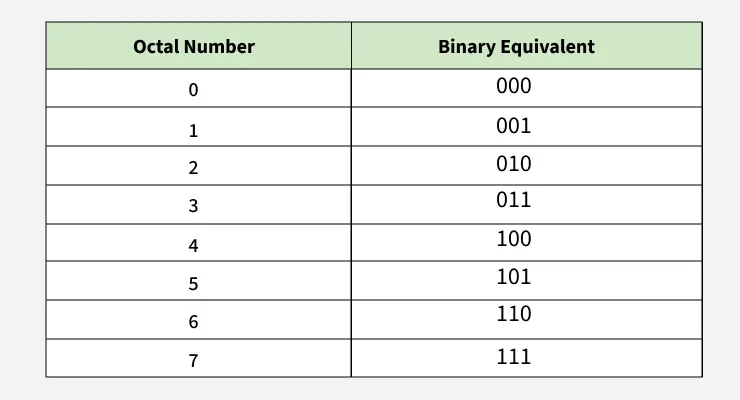
The table below shows the relationship between octal and binary numbers (each octal digit represents 3 bits in binary):
'OCTAL' is derived from the Latin word 'OCT', which means Eight. The number system with base 8 and symbols ranging between 0-7 is known as the Octal Number System. Each digit of an octal number represents a power of 8. It is widely used in computer programming and digital systems. Octal number system can be converted to other number systems and visa versa.
For example, an octal number (10)8 is equivalent to 8 in the decimal number system, 001000 in the binary number system and 8 in the hexadecimal number system.
Octal Numbers are represented with digits 0-7 and with base 8. Conversion of a number system means conversion from one base to another. Following are the conversions of the Octal Number System to other Number Systems:
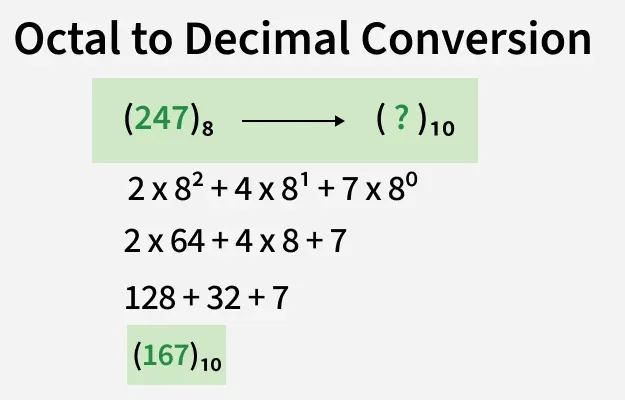
Octal numbers are represented in base 8, but the decimal numbers are of base 10. Hence, to convert an octal number to a decimal number, the base of that number is to be changed.
Example: (247)8 is to be converted to decimal:
Follow the steps given below:
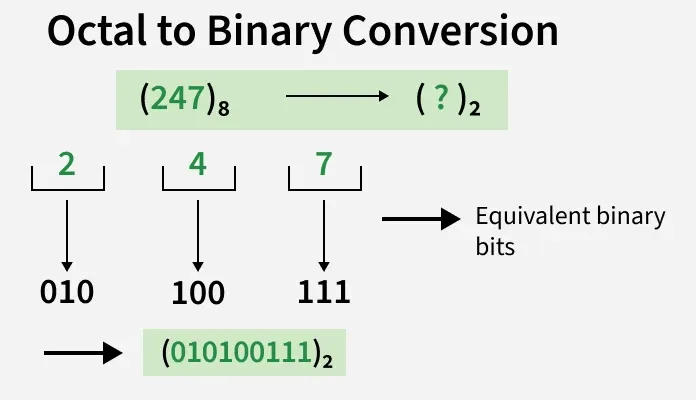
Octal numbers are represented in base 8, but the binary numbers are of base 2. Hence, to convert an octal number to a binary number, the base of that number is to be changed.
Example: (247)8 is to be converted to binary
Follow the steps given below:
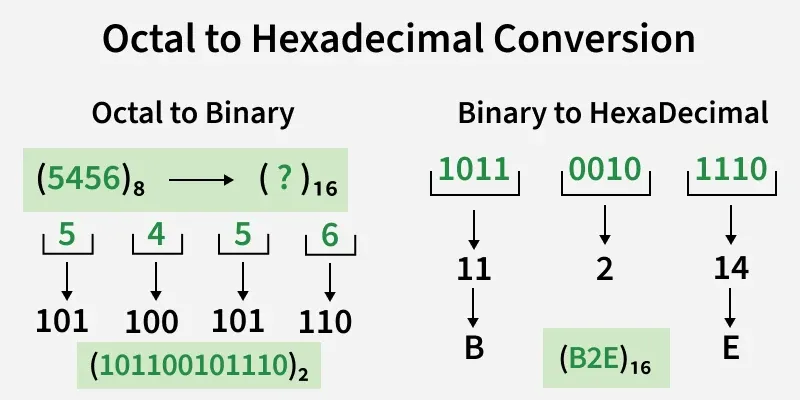
Octal numbers are represented in base 8, but the hexadecimal numbers are of base 16. Hence, to convert an octal number to a hex number, the base of that number is to be changed.
Example: (5456)8 is to be converted to hex
Follow the steps given below:
The image added below shows binary to octal conversion.
Follow the steps given below:
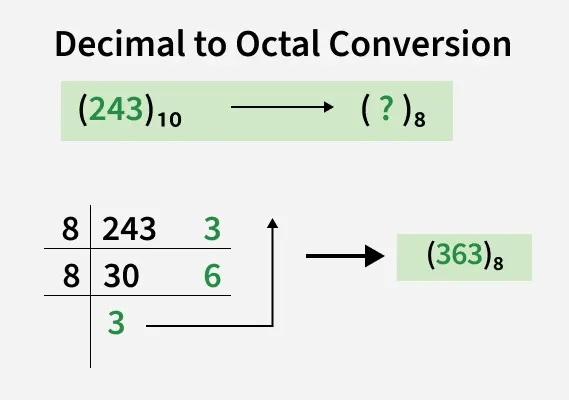
To convert a decimal number to an octal number follow these simple steps:
Octal Multiplication table is added below,
× | 0 | 1 | 2 | 3 | 4 | 5 | 6 | 7 |
|---|---|---|---|---|---|---|---|---|
0 | 0 | 0 | 0 | 0 | 0 | 0 | 0 | 0 |
1 | 0 | 1 | 2 | 3 | 4 | 5 | 6 | 7 |
2 | 0 | 2 | 4 | 6 | 10 | 12 | 14 | 16 |
3 | 0 | 3 | 6 | 11 | 14 | 17 | 22 | 25 |
4 | 0 | 4 | 10 | 14 | 20 | 24 | 30 | 34 |
5 | 0 | 5 | 12 | 17 | 24 | 31 | 36 | 43 |
6 | 0 | 6 | 14 | 22 | 30 | 36 | 44 | 52 |
7 | 0 | 7 | 16 | 25 | 34 | 43 | 52 | 61 |
Example 1: What is Decimal Equivalent of 11218?
Solution:
11218 = 1 × 83 + 1 × 82 + 2 × 81 + 1 × 80
11218 = 1 × 512 + 1 × 64 + 2 × 8 + 1 × 1
11218 = 512 + 64 + 16 + 1 = 593Hence, 11218 = 59310
Example 2: Convert 278 into the binary number.
Solution:
Write binary equivalent of each digit of 278
2 ---> 010
7 ---> 111Hence 278 = 0101112
Example 3: Find the octal equivalent of 10010012.
Solution:
Breaking 10101111 into groups of three starting from rightmost digit and adding leading zeroes we get:
001, 001, 001
Write the octal equivalent of the groups formed
001 -> 1
001 -> 1
001 -> 1Answer is (111)8
Example 4: Represent 1238 as a Decimal Number.
Solution:
1238 = 1 × 82 + 2 × 81 + 3 × 80
⇒ 1238 = 1 × 64 + 2 × 8 + 3 × 1
⇒ 1238 = 64 + 16 + 3
⇒ 1238 = 8310Hence 8310 is decimal representation of 1238.
Question 1: Convert 12110 to an octal number.
Question 2: What is Octal Value of 1000100002?
Question 3: Find the Decimal Equivalent of 558.
Question 4: Convert 12F16 to Octal number.
Question 5: What will be the binary value of 578?
Answer Key:
- 171
- 420
- 45
- 457
- 101111