|
VOOZH | about |
|
VOOZH | about |
Whole numbers are the set of natural numbers (1, 2, 3, 4, 5, ...) plus zero. They do not include negative numbers, fractions, or decimals. Whole numbers range from zero to infinity.
Natural numbers are a subset of whole numbers, and whole numbers are a subset of real numbers. Therefore, all natural numbers are whole numbers, and all whole numbers are real numbers, but not every real number is a whole number.
👁 Difference between Whole Numbers and Natural NumbersZero is the smallest whole number, meanwhile there isn't a biggest whole number because the set of whole numbers is infinite.
Other types of numbers:
- Natural Numbers: N = {1, 2, 3, 4, 5, 6, 7, 8, 9,…}
- Integers: Z = {….-9, -8, -7, -6, -5, -4, -3, -2, -1, 0, 1, 2, 3, 4, 5, 6, 7, 8, 9,…}
- Rational Numbers: Q = { }
(All numbers that can be expressed as a fraction , where a and b are integers and b ≠ 0.)
Let's learn about the definition, symbols, properties, and examples of whole numbers in detail, along with some numerical examples and worksheets.
It can be said that the whole number is a set of numbers without fractions, decimals, and negative numbers.
The symbol to represent whole numbers is the alphabet ‘W’ in capital letters.
The whole numbers list includes 0, 1, 2, 3, 4, 5, 6, 7, 8, 9, 10, to infinity.
W = {0, 1, 2, 3, 4, 5, 6, 7, 8, 9, 10,…}
The set of whole numbers includes the set of natural numbers along with the number 0. The set of whole numbers in mathematics is given as {0, 1, 2, 3, ...}
- All whole numbers come under real numbers.
- All natural numbers are whole numbers but not vice-versa.
- All positive integers, including 0, are whole numbers.
- All counting numbers are whole numbers.
- Every whole number is a rational number.
Whole numbers can be easily observed on the number line. They are represented as a collection of all the positive integers, along with 0.
The visual representation of whole numbers on the number line is given below:
👁 Whole Numbers on Number Line
A Whole Number has the following key properties:
| Property | Description(where W is a whole number) |
|---|---|
| Closure Property | x + y = W OR x × y = W |
| Commutative Property of Addition | x + y = y + x |
| Commutative Property of Multiplication | x × y = y × x |
| Additive Identity | x + 0 = x |
| Multiplicative Identity | x × 1 = x |
| Associative Property | x + (y + z) = (x + y) + z OR x × (y × z) = (x × y) × z |
| Distributive Property | x × (y + z) = (x × y) + (x × z) |
| Multiplication by Zero | a × 0 = 0 |
| Division by Zero | a/0 is undefined |
Let's discuss them in detail.
The sum and the product of two whole numbers will always be a whole number.
x + y = W
x × y = W
For example: Prove the closure property for 2 and 5.
2 is a whole number, and 5 is a whole number. To prove the closure property, add and multiply 2 and 5.
2 + 5 = 7 (Whole number).
2 × 5 = 10 (Whole number).
In the commutative property of addition, the sum of any two whole numbers is the same. i.e., the order of addition doesn't matter. i.e.,
x + y = y + x
For Example: Prove the commutative property of addition for 5 and 8.
According to the commutative property of addition:
x + y = y + x
5 + 8 = 13
8 + 5 = 13Therefore, 5 + 8 = 8 + 5
The multiplication of any two whole numbers is the same. Any number can be multiplied in any order. i.e.,
x × y = y × x
For example: Prove the commutative property of multiplication for 9 and 0.
According to the commutative property of multiplication:
x + y = y + x
9 × 0 = 0
0 × 9 = 0Therefore, 9 × 0 = 0 × 9
In the additive property, when we add the value with zero, then the value of the integer remains unchanged. i.e.,
x + 0 = x
For example: Let's prove the numbers property for 7.
According to additive property
x + 0 = x
7 + 0 = 7Hence, proved.
When we multiply a number by 1, then the value of the integer remains unchanged. i.e.,
x × 1 = x
For example: Prove multiplicative property for 13.
According to multiplicative property:
x × 1 = x
13 × 1 = 13Hence, proved.
When adding and multiplying the numbers and grouped together in any order, the value of the result remains the same. i.e.,
x + (y + z) = (x + y) + z
and
x × (y × z) = (x × y) × z
For example: Prove the associative property of multiplication for the whole numbers 10, 2, and 5.
According to the associative property of multiplication:
x × (y × z) = (x × y) × z
10 × (2 × 5) = (10 × 2) × 5
10 × 10 = 20 × 5
100 = 100Hence, Proved.
When multiplying the numbers and distributing them in any order, the value of the result remains the same. i.e.,
x × (y + z) = (x × y) + (x × z)
For example: Prove the distributive property for 3, 6, and 8.
According to the distributive property:
x × (y + z) = (x × y) + (x × z)
3 × (6 + 8) = (3 × 6) + (3 × 8)
3 × (14) = 18 + 24
42 = 42Hence, Proved.
Multiplication by the zero is a special multiplication as multiplying any number by zero yields the result zero. i.e.
a × 0 = 0
For example: Find 238 × 0.
= 238 × 0
we know that multiplying any number yield the result zero.
= 0
Division is the inverse operation of multiplication. But division by zero is undefined, we can not divide any number by zero, i.e.
a/0 is undefined
Read More :
A natural number is any whole number that is not zero. Furthermore, all natural numbers are whole numbers. Therefore, the set of natural numbers is a part of the set of whole numbers.
Let's discuss the difference between natural numbers and whole numbers.
Whole Numbers vs. Natural Numbers | |
|---|---|
Natural Numbers | Whole Numbers |
| Smallest natural number is 1. | Smallest whole number is 0. |
| Set of natural numbers (N) is {1, 2, 3, ...}. | Set of whole numbers (W) is {0, 1, 2, 3, ...} |
| Every natural number is a whole number. | Every whole number is not a natural number. |
Two important sets of numbers you’ll often encounter are whole numbers and integers. Differences Between Whole Numbers and Integers are given below:
Feature | Whole Numbers | Integers |
|---|---|---|
Includes zero | Yes | Yes |
Positive numbers | Yes | Yes |
Negative numbers | No | Yes |
Decimals/Fractions | No | No |
Set notation | {0, 1, 2, 3, .....} | {…,−3,−2,−1, 0 , 1 , 2 , 3 , .....} |
Whole numbers are the foundation of arithmetic. Understanding how they work with basic operations—addition, subtraction, multiplication, and division—is essential for mastering math skills used in school and everyday life.
Addition is the process of putting two or more numbers together to make a larger total.Example: 7 + 5 = 12
Properties of Addition:
- Commutative: a + b = b + a
- Associative: (a + b) + c = a + (b + c)
- Identity Element: a + 0 = a
Subtraction is used to find how much one number is greater than another, or how much is left when something is taken away.
Example: 9 - 4 = 5
Multiplication is a quick way to add the same number multiple times.
Example: 6 × 3 = 18
Properties of Multiplication:
- Commutative: a × b = b × a
- Associative: (a × b) × c = a × (b × c)
- Identity Element: a × 1 = a
- Zero Property: a × 0 = 0
Division is the process of splitting a number into equal groups or parts.
Example: 12 / 3 = 4
Read More:
Question 1: Are the numbers 100, 399, and 457 whole numbers?
Solution:
Yes, the numbers 100, 399, 457 are the whole numbers.
Question 2: Solve the equation 15 × (10 + 5) using the distributive property.
Solution:
We know that distributive property are:
x × (y + z) = x × y + x × z
So, 15 × 10 + 15 × 5 = 150 + 75
= 225.
Question 3: Prove the associative property of multiplication for the whole numbers 1, 0, and 93.
Solution:
According to the associative property of multiplication:
x × (y × z) = (x × y) × z
1 × (0 × 93) = (1 × 0) × 93
1 × 0 = 0 × 93
0 = 0
Hence, Proved.
Question 4: Write down the number that does not belong to the whole numbers:
4, 0, -99, 11.2, 45, 87.7, 53/4, 32.
Solution:
Out of the numbers mentioned above, it can easily be observed that 4, 0, 45, and 32 belong to whole numbers. Therefore, the numbers that do not belong to whole numbers are -99, 11.2, 87.7, and 53/4.
Question 5: Write 3 whole numbers occurring just before 10001.
Solution:
If the sequence of whole numbers are noticed, it can be observed that the whole numbers have a difference of 1 between any 2 numbers. Therefore, the whole numbers before 10001 will be: 10000, 9999, 9998.
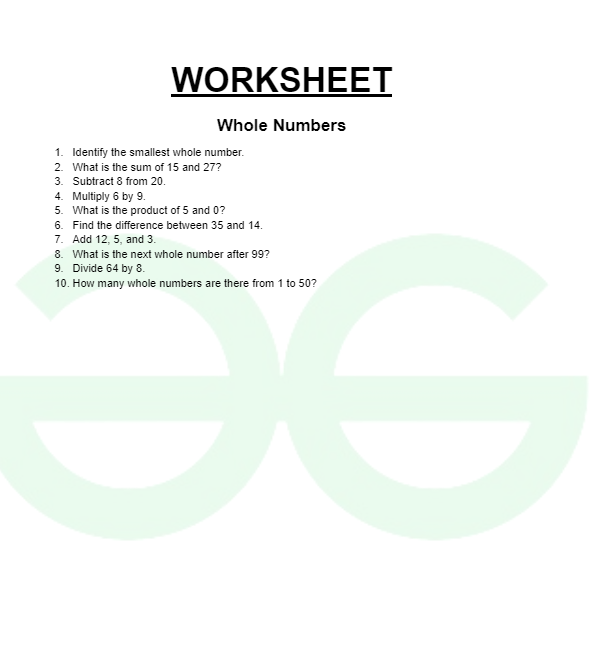
You can download this worksheet from below with answers:
The set of natural numbers that includes zero is known as whole numbers: 0, 1, 2, 3, 4, and so on. In terms of whole numbers, they are non-negative integers, which means that they begin at zero and go indefinitely in a positive direction without containing fractions or decimals. In many mathematical operations, including counting, addition, subtraction, multiplication, and division, whole numbers are necessary. Understanding the characteristics and functions of whole numbers is essential in the teaching of mathematics and establishes the foundation for additional mathematical exploration.

.png)
.png)