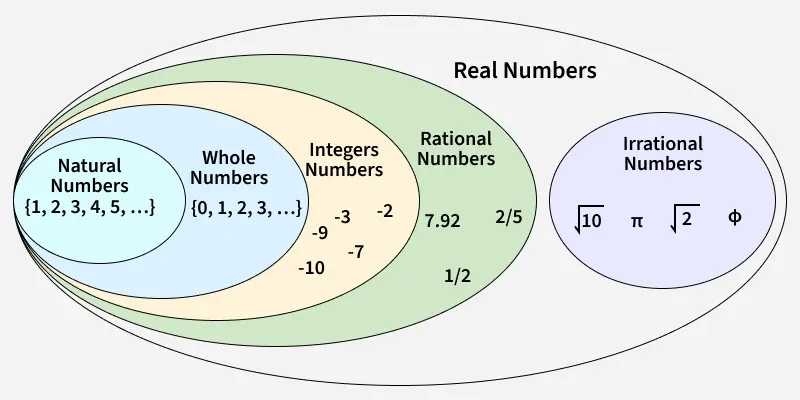
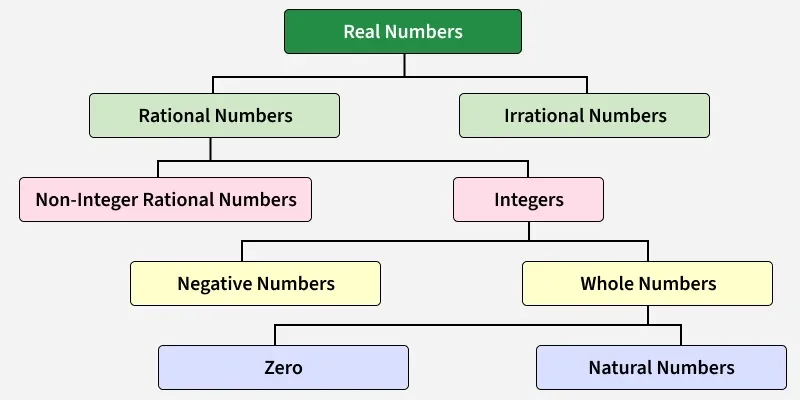
Real numbers are the set of numbers that can represent a quantity along a continuous number line. They include both rational and irrational numbers and can be positive, negative, or zero.
1. Rational Numbers (ℚ): Numbers that can be expressed as a fraction (p/q) where both the numerator represented as p and the denominator represented as q are integers, and the denominator (q) is not zero. Rational numbers include integers, finite decimals, and repeating decimals (e.g., 1/2, -3, 0.75).
2. Irrational Numbers: Numbers that cannot be expressed in the form of a simple fraction p/q where 'p' and 'q' are integers and the denominator 'q' is not equal to zero (q≠0) and have non-terminating, non-repeating decimal expansions. They cannot be represented as a fraction of two integers (e.g., √2, π).
Real numbers can be further divided into the following subsets:
Category
Description
Examples
Natural Numbers
Counting numbers used in daily life, starting from 1.
1, 2, 3, 4, 5, ...
Whole Numbers
Natural numbers including 0.
0, 1, 2, 3, 4, 5, ...
Integers
Whole numbers and negative natural numbers, including a neutral number (0).
..., -3, -2, -1, 0, 1, 2, 3, ...
Symbols
We use R to represent a set of real numbers, and other types of numbers can be represented using the symbol discussed below.
Natural Numbers
N
Whole Numbers
W
Integers
Z
Rational Numbers
Q
Irrational Numbers
Q'
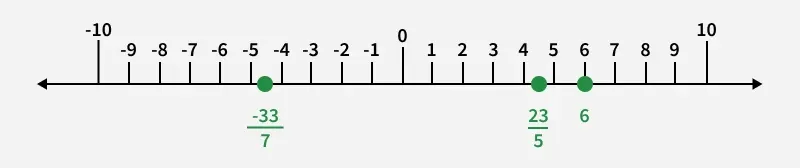
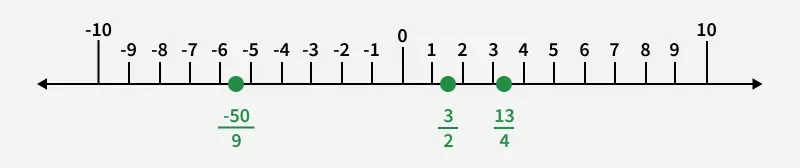
Real Numbers on a Number Line
When real numbers are placed on a number line, each value corresponds to a unique point on that line. The number line extends infinitely in both the positive and negative directions.