|
VOOZH | about |
|
VOOZH | about |
The bisection method is a technique for finding solutions to equations with a single unknown variable. Among various numerical methods, it stands out for its simplicity and effectiveness, particularly when dealing with transcendental equations (those that cannot be solved using algebraic methods alone). The method is also called the interval halving method, the binary search method or the dichotomy method.
This method is used to find root of an equation in a given interval that is value of 'x' for which f(x) = 0 .
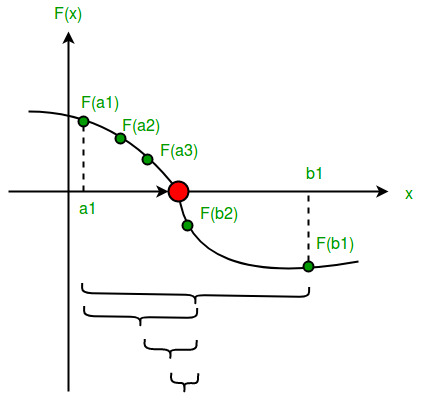
The bisection method is based on the Intermediate Value Theorem, which states that if f(x) is a continuous function on the interval [a, b] and f(a) and f(b) have opposite signs (i.e., f(a)⋅f(b)<0), then there is at least one root of the equation f(x)=0 in the interval (a,b).
- f(x) is a continuous function on the interval [a, b].
- f(a)⋅f(b) < 0 ( i.e., the function values at a and b have opposite signs).
Example: Finding the Root of a Polynomial
We use the bisection method to find the root of the polynomial: f(x)=x3−x−2
Step 1: Initial Interval Selection Choose a= 1 and b= 2.
Evaluate the function: f(1) = −2, f(2) = 4Since f(1) and f(2) have opposite signs, there is a root between 1 and 2.
Step 2: First Iteration, Calculate the midpoint:
Evaluate the function at c1 : f(1.5) = −0.125Since f(1.5) is negative, update the interval to [1.5, 2].
Step 3: Repeat: Repeat the process until the interval becomes sufficiently small, converging on the root.
A few steps of the bisection method applied over the starting range [a1;b1]. The bigger red dot is the root of the function.
Below is implementation of above steps.
Output:
The value of root is : -1.0025Determine the root of the given equation x2−3 = 0 for x∈[1,2]x .
Solution:
Given: x2−3=0
Let f(x)=x2−3.
Now, find the value of f(x)at a=1 and b=2.
f(1)=12−3=1−3=−2 (which is <0),
f(2)=22−3=4−3=1 (which is >0)
The given function is continuous, and since f(1)⋅f(2) < 0 , the root lies in the interval [1, 2].
Let t be the midpoint of the interval:
Now, find the value of the function at t=1.5 :
f(1.5)=(1.5)2−3=2.25−3=−0.75 (which is <0)
Since f(1.5) < 0 , we update a = t = 1.5.
Iterations for the Given Function:
| Iteration | a | b | t | f(a) | f(b) | f(t) |
|---|---|---|---|---|---|---|
| 1 | 1 | 2 | 1.5 | -2 | 1 | -0.75 |
| 2 | 1.5 | 2 | 1.75 | -0.75 | 1 | 0.062 |
| 3 | 1.5 | 1.75 | 1.625 | -0.75 | 0.0625 | -0.359 |
| 4 | 1.625 | 1.75 | 1.6875 | -0.359 | 0.0625 | -0.1523 |
| 5 | 1.6875 | 1.75 | 1.7188 | -0.1523 | 0.0625 | -0.0457 |
| 6 | 1.7188 | 1.75 | 1.7344 | -0.0457 | 0.0625 | 0.0081 |
| 7 | 1.7188 | 1.7344 | 1.7266 | -0.0457 | 0.0081 | -0.0189 |
At iteration 7, the final interval is [1.7266, 1.7344].
Hence, the approximated solution is 1.7344.
Disadvantage of Bisection Method is that it cannot detect multiple roots.
Problem 1: Use the bisection method to find the root of f(x) = x2−5 in the interval [2,3] up to 4 decimal places.
Problem 2: Apply the bisection method to solve f(x) = cos(x)−x in the interval [0, 1] up to 3 decimal places.
Problem 3: Use the bisection method to find the root of f(x) = x3−2x−5min the interval [2 , 3 ]up to 5 decimal places.
Problem 4: Solve the equation f(x) = x2−2x−3 for a root in the interval [1, 4] using the bisection method.
Problem 5: Use the bisection method to approximate the root of f(x)=ex−3 in the interval [0, 2] to 3 decimal places.
How accurate is the bisection method?
The accuracy of the bisection method depends on the number of iterations. The method guarantees convergence, but it has a linear rate of convergence, meaning it can take more iterations compared to methods like Newton’s method
What are Algebraic and Transcendental functions?
Algebraic function are the one which can be represented in the form of polynomials like f(x) = a1x3 + a2x2 + ..... + e where aa1, a2, ... are constants and x is a variable.
Transcendental function are non algebraic functions, for example f(x) = sin(x)*x - 3 or f(x) = ex + x2 or f(x) = ln(x) + x ....
Can the bisection method find all types of roots?
The bisection method can find real roots of continuous functions. However, it cannot handle cases where the root is complex or where the function is not continuous.
What happens if f(a)⋅f(b) ≥ 0 ?
If f(a)⋅f(b) ≥ 0, the method cannot be applied because it indicates that either no root exists in the interval or there may be multiple roots or the root might not be in the interval.
How does the bisection method compare to other root-finding methods?
The bisection method is slower compared to methods like Newton's method or secant method, but it is more robust and simple to implement, especially for functions where derivatives are difficult to compute.