|
VOOZH | about |
|
VOOZH | about |
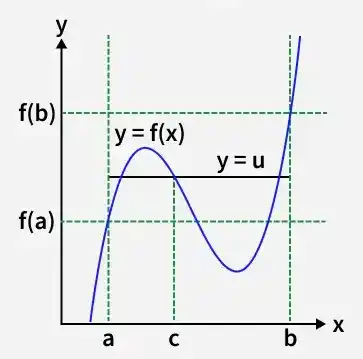
The Intermediate Value Theorem (IVT) applies to continuous functions on a closed interval. It guarantees that the function attains every value between f(a) and f(b).
Statement: If (f) is continuous on [a, b] and (d) is any real number between f(a) and f(b), then there exists at least one c ∈ (a, b) such that f(c) = d.
A continuous function cannot skip values between f(a) and f(b). If f(a) and f(b) have opposite signs, then there exists at least one c ∈ (a,b) such that f(c) = 0.
The completeness property of real numbers states that every non-empty set of real numbers that has an upper bound also has a smallest upper bound, called the supremum (least upper bound).
We have a continuous function f defined on the interval [a, b], and d lies between f(a) and f(b). To prove that there exists c ∈ [a, b] such that f(c) = d, define a set,
S = {x ∈ [a, b] | f(x) ≤ d}
Now, the upper bound of set S is b, since every x∈[a, b] satisfies x ≤ b. By the completeness property, S has a supremum
c = sup S
Let f(c) ≠ d, then two cases arise,
From the contradictions proved above, therefore f(c) = d.
Hence, we have proved that there exists c ∈ [a, b] such that f(c) = d, which proves the Intermediate Value Theorem.
Various applications of the Intermediate Value Theorem are as follows:
These are limitations of IVT, discussed as follows:
Example 1: Check whether the function defined as f(x) = x3 - 8 has a root in the interval [0,4].
Solution:
Here, we have,
- f(0) = 0 - 8 = -8, and
- f(4) = 43 - 8 = 64 - 8 = 56.
As the function yields values with opposite signs at the endpoints of the given interval, by intermediate value theorem, it implies that the function has at least one root in the interval.
Example 2: Show that the function defined as f(x) = ex - 3x has a root in the interval [0,1].
Solution:
To show whether the function has a root in the given interval, we check the value of function at the endpoints of the interval,
We have, f(0) = e0 - 3(0) = 1 - 0 = 1, and
f(1) = e - 3 = -0.28 (approx.)
Thus, we see that function has opposite signed values at endpoints of the interval, so it has at least one root in the interval.
Q1: Check whether the function defined as f(x) = x2 - 2x has a root in the interval [0, 1].
Q2: Show that the function defined by f(x) = 1 - 2sin(x) has at least one root in the interval [0, π/2].
Q3: Consider the function f(x) = x3 - x + 2, check whether it has a root in the interval [1, 4].
Q4: Check whether the function given by f(x) = 4x - ex has a root in the interval [0, 1].
Q5: Show that the function defined as f(x) = x5 - x has at least one root in the interval [-1, 1].