|
VOOZH | about |
|
VOOZH | about |
Given a hexadecimal number as input, we need to write a program to convert the given hexadecimal number into an equivalent decimal number.
Examples:
Input : 67
Output: 103

Input : 512
Output: 1298

Input : 123
Output: 291
We know that hexadecimal number uses 16 symbols {0, 1, 2, 4, 5, 6, 7, 8, 9, A, B, C, D, E, F} to represent all numbers. Here, (A, B, C, D, E, F) represents (10, 11, 12, 13, 14, 15).
The idea is to extract the digits of a given hexadecimal number starting from the rightmost digit and keep a variable dec_value. At the time of extracting digits from the hexadecimal number, multiply the digit with the proper base (Power of 16) and add it to the variable dec_value. In the end, the variable dec_value will store the required decimal number.
For Example: If the hexadecimal number is 1A.
dec_value = 1*(161) + 10*(160) = 26
The number which can be represented using the numbers in the range of (0-9) are termed as decimal number which has the base 10 to it.
For example, The number 123 is a decimal number where:
Thus, 123 = 1×100 + 2×10 + 3×1.
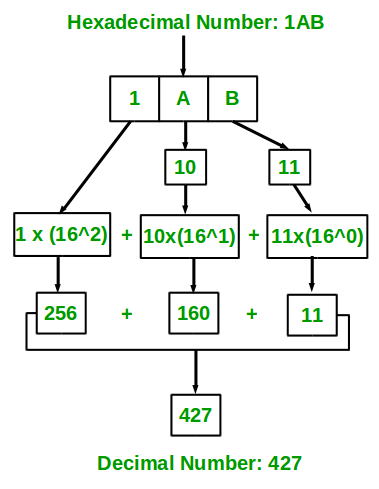
The below diagram explains how to convert a hexadecimal number (1AB) to an equivalent decimal value:
Below is the implementation of the above idea.
26
Time Complexity: O(N), where N is the number of digits in the given hexadecimal number.
Space Complexity: O(1).
Using predefined function
26
Time complexity: O(1) - the conversion of hexadecimal to decimal is done in constant time using the stoi function.
Auxiliary Space: O(1) - the only space used is for the string n and the returned integer value, which are constant in size regardless of the input value.