|
VOOZH | about |
|
VOOZH | about |
Given a function f(x) on floating number x and an initial guess for root, find root of function in interval. Here f(x) represents algebraic or transcendental equation.
For simplicity, we have assumed that derivative of function is also provided as input.
Example:
Input: A function of x (for example x3 – x2 + 2),
 derivative function of x (3x2 – 2x for above example)
 and an initial guess x0 = -20
Output: The value of root is : -1.00
 OR any other value close to root.
We have discussed below methods to find root in set 1 and set 2
Set 1: The Bisection Method
Set 2: The Method Of False Position
Comparison with above two methods:
The formula:
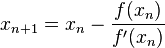
Starting from initial guess x1, the Newton Raphson method uses below formula to find next value of x, i.e., xn+1 from previous value xn.
Advantages of Newton Raphson Method:
Disadvantages of Newton Raphson Method:
Algorithm:
Input: initial x, func(x), derivFunc(x)
Output: Root of Func()
Below is the implementation of above algorithm.
Output:
The value of root is : -1.00
How does this work?
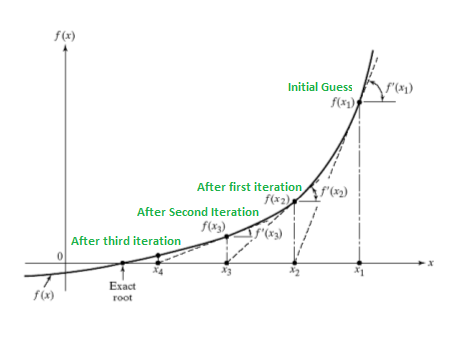
The idea is to draw a line tangent to f(x) at point x1. The point where the tangent line crosses the x axis should be a better estimate of the root than x1. Call this point x2. Calculate f(x2), and draw a line tangent at x2.
We know that slope of line from (x1, f(x1)) to (x2, 0) is f'(x1)) where f' represents derivative of f.
f'(x1) = (0 - f(x1)) / (x2 - x1)

f'(x1) * (x2 - x1) = - f(x1)

x2 = x1 - f(x1) / f'(x1)

By finding this point 'x2', we move closer towards the root.
We have to keep on repeating the above step till we get really close to
the root or we find it.

In general,
xn+1 = xn - f(xn) / f'(xn)
Alternate Explanation using Taylor's Series:
Let x1 be the initial guess.

We can write x2 as below:
 xn+1 = xn + h ------- (1)
Here h would be a small value that can be positive or negative.

According to Taylor's Series,
ƒ(x) that is infinitely differentiable can be written as below
f(xn+1) = f(xn + h)
 = f(xn) + h*f'(xn) + ((h*h)/2!)*(f''(xn)) + ...

Since we are looking for root of function, f(xn+1) = 0

f(xn) + h*f'(xn) + ((h*h)/2!)*(f''(xn)) + ... = 0

Now since h is small, h*h would be very small.
So if we ignore higher order terms, we get

f(xn) + h*f'(xn) = 0

Substituting this value of h = xn+1 - xn from equation (1) we get,
f(xn) + (xn+1 - xn)*f'(xn) = 0

xn+1 = xn - f(xn) / f'(xn)
Notes:
References:
Introductory Methods of Numerical Analysis by S.S. Sastry
https://en.wikipedia.org/wiki/Newton's_method
http://www.cae.tntech.edu/Members/renfro/me2000/lectures/2004-09-07_handouts.pdf/at_download/file